
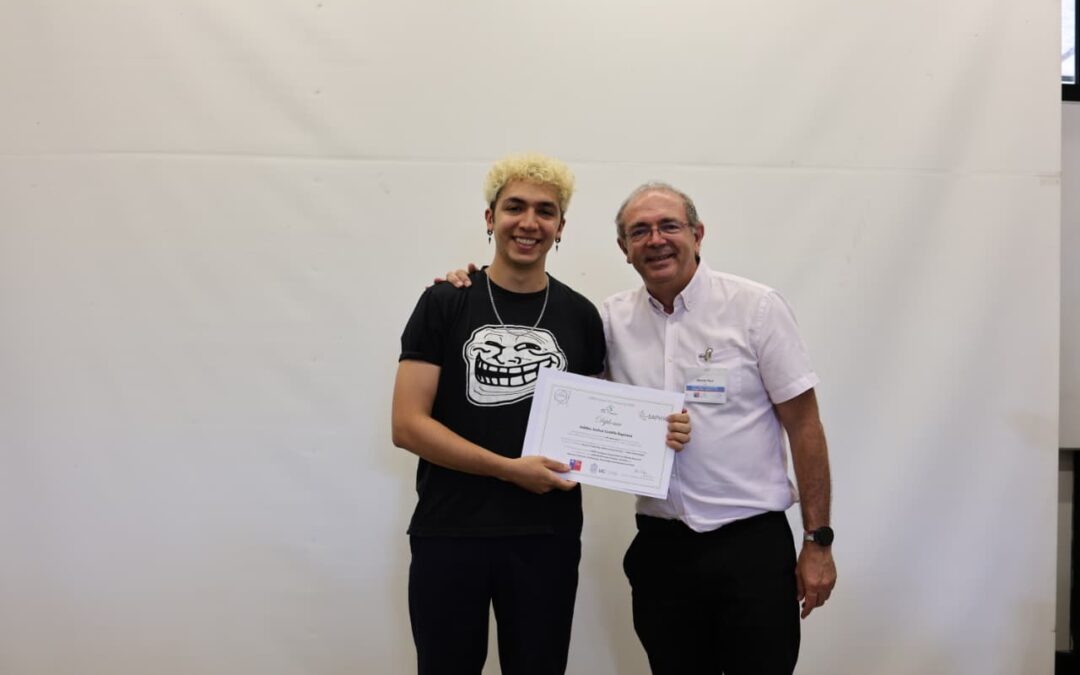
Between January 12 and 23, 2026, the CERN School of Computing 2026 (CSC26) was held at the Lo Contador Campus of the Pontifical Catholic University of Chile. The school brought together 69 master's and doctoral students, along with professionals from Chile, Latin America, Europe, and other regions, who participated in two weeks of intensive training focused on computing for science, combining classes and practical exercises in an environment of international academic collaboration.
In this context, we would like to highlight the participation of Addles Castillo, a doctoral student at Andrés Bello University and member of the Millennium Institute SAPHIR, who has been part of the institute since its inception as an undergraduate student. Addles obtained the highest score in the final evaluation of the CERN School of Computing 2026.
In this regard, it should be noted that CSC26 is a school with a focus on computing for science, which combined classes and practical exercises over two weeks of intensive training. The program was structured around three training areas: computing applied to physics, software engineering, and data technologies, and was developed under European standards of academic excellence.
Regarding his experience and the recognition he received, Addles Castillo said that "getting the highest score at the CERN School of Computing was completely unexpected for me," confessing that he even hesitated to take the final exam because he didn't feel prepared and also had a cold. "It was thanks to my girlfriend's insistence that I finally decided to take it, and today I can say that it was one of the best decisions I ever made," he said.
The student particularly valued the educational impact of the school, noting that "the teaching was first-rate and solidly reinforced my knowledge of scientific computing, software, and data analysis applied to physics." However, he emphasized that the experience went far beyond the academic. "Beyond academic achievement, the most valuable thing was the human experience: meeting incredibly talented, kind, and fun people from all over the world," he said.
Along the same lines, he emphasized the lasting nature of the encounter: "I may forget some of the technical details I learned at school over time, but I will never forget the friends I made there."
The hosting of the CERN School of Computing 2026 in Chile not only reaffirms the country's capacity to host high-level international training events, but also highlights the role of students as key players in the global scientific ecosystem.
The Millennium Institute SAPHIR is extremely proud that one of its students currently in training achieved the highest score and stood out during the course. Addles Castillo has had an outstanding track record at SAPHIR for several years, actively participating in various training and outreach programs, including the Summer School at CERN, specialized Latin American schools, and multiple outreach activities that the institute develops in collaboration with society. In the words of the executive director, Mr. Felipe Olivares León: "We congratulate Addles Castillo on this outstanding distinction and reaffirm, as the SAPHIR Millennium Institute, our commitment to the training of advanced human capital, the strengthening of the local scientific and technological ecosystem, and the international projection of the talent that is being trained in Chile."