
EXPERIMENT
SND@LHC:
SND@LHC (Scattering and Neutrino Detector at the LHC) is an experiment designed to study neutrinos, fundamental particles that have no electrical charge and whose mass is extremely small.
Although particle colliders produce neutrinos in large quantities, a neutrino has never been directly observed in a collider. This is because they interact very weakly with matter, so they often go undetected in conventional detectors. Furthermore, most of the neutrinos generated at the LHC are in a little-explored energy range, making their study especially interesting.
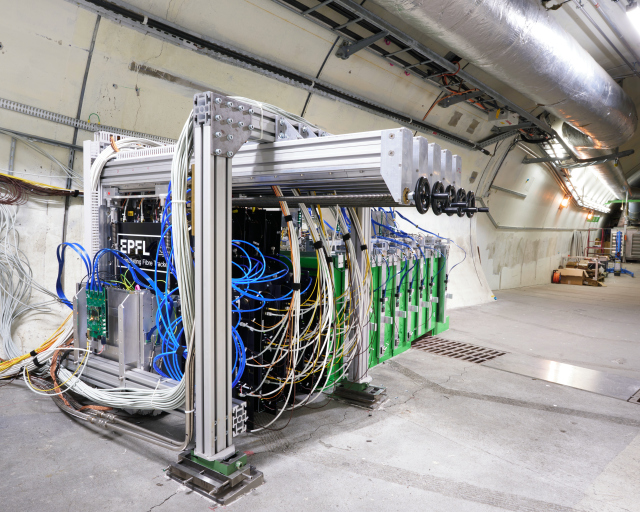
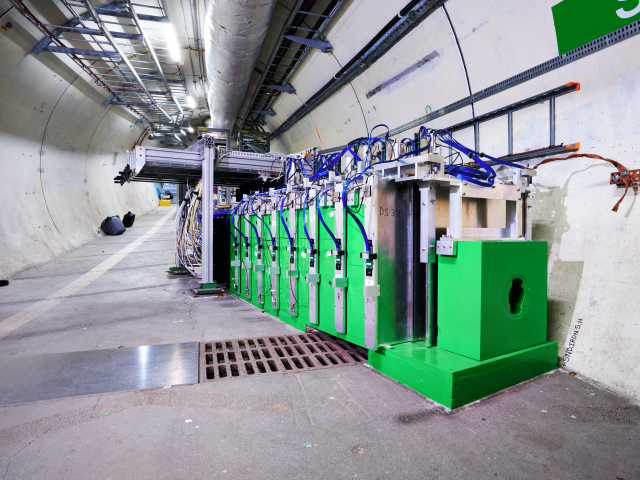
The SND@LHC detector consists of a neutrino target, followed by a device that measures its energy and detects the muons—particles similar to electrons, but heavier—produced when neutrinos interact with the target.
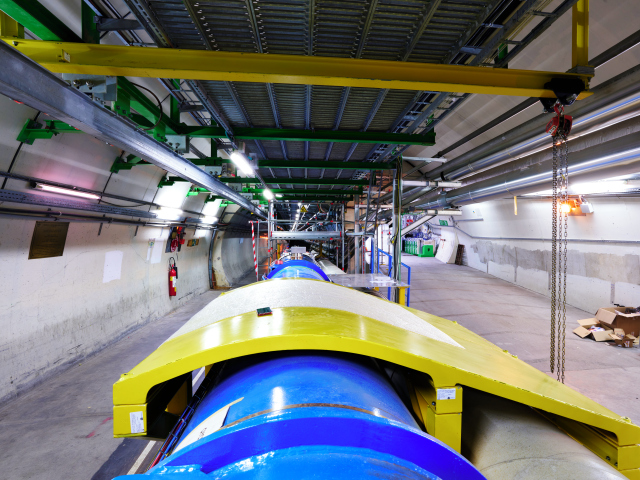
This system is installed underground, near the ATLAS experiment, in a disused tunnel connecting the LHC to the Super Proton Synchrotron (SPS). Located slightly outside the LHC beamline, the detector can detect neutrinos produced in LHC collisions that emerge at small angles to the beam. These angles are wider than those covered by FASERν, a subdetector of the FASER experiment that also studies neutrino interactions at high energies, but is located directly above the beamline.
A large proportion of the neutrinos detected by SND@LHC come from the decays of particles made of heavy quarks, so the experiment also allows the production of these types of particles to be studied in an angular range inaccessible to other LHC experiments.
In addition, SND@LHC searches for weakly interacting particles not predicted by the Standard Model, which could constitute dark matter.
The experiment was approved in 2021, built, installed, and put into operation underground in about a year. It began collecting data during LHC Run 3, which began in July 2022.
The SAPHIR Millennium Institute has been consolidating its participation in the SND@LHC experiment, a pioneering CERN initiative dedicated to the study of neutrinos produced in collisions of the Large Hadron Collider (LHC), as well as to the search for signals of new physics. Within this collaboration, SAPHIR has played a key role in several stages of the design, testing and production of fundamental components of the detector. Among its most outstanding contributions is the work with TOF (Time-of-Flight) modules, where Chilean researchers have led the design, laboratory tests and validations in beam tests, all oriented to improve the temporal resolution for the precise identification of particles. In addition, the SAPHIR team has participated in the production of a prototype of the Shashlik-type electromagnetic calorimeter, using SiPMs (Silicon Photomultipliers) photodetectors, and has collaborated in its tests with particle beams directly at CERN. An innovative aspect of the institute's work is the development of scanning microscopy data analysis at the Universidad Andres Bello, a critical technique for the accurate characterization of the interactions recorded by the detector. Finally, SAPHIR actively collaborates in joint research and development work with pion beams, contributing to the fine-grained understanding of the detector's performance against different types of particles. This participation reinforces the institute's commitment to high energy physics and positions Chile as an emerging player in frontier experimental research.
