
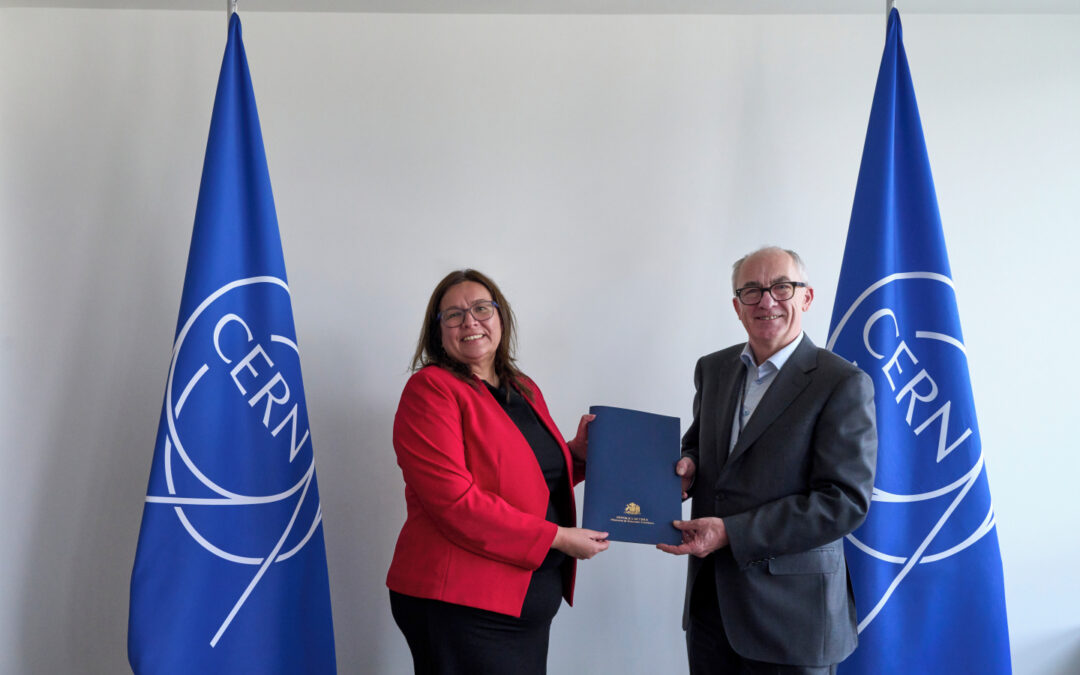
On Thursday, Chile officially became an Associate Member State of the European Organization for Nuclear Research (CERN), following the ratification of the agreement signed by both parties and its accession to the protocol on the privileges and immunities of this organization, the world’s leading institution in particle physics research.
The SAPHIR Millennium Institute is celebrating this significant milestone, which marks a turning point in the history of Chilean science and positions the country for a more active role in cutting-edge research.
Chile’s accession to CERN is not an isolated event, but rather the result of more than four decades of sustained collaboration between the national scientific community and this international organization. From the first ties established in the 1980s, through the participation of Chilean groups in Large Hadron Collider (LHC) experiments in the 2000s, to the growing institutionalization of this relationship over the past decade, Chile has built a solid track record in high-energy physics.
In this process, the SAPHIR Millennium Institute has played a key role in coordinating scientific and technological capabilities. Since its creation in 2020, the Institute has strengthened and expanded Chile’s participation at CERN by integrating efforts in theoretical and experimental physics, the development of advanced instrumentation, and large-scale data analysis.
The history of collaboration—which includes the participation of Chilean researchers in the ATLAS experiment since the mid-2000s, the training of students at CERN schools, and the signing of scientific cooperation agreements—finds in SAPHIR an institutional framework that strengthens and coordinates these initiatives. In particular, the Institute has helped strengthen Chile’s presence in strategic projects, including the development of detectors and technological systems, as well as integration into new experimental lines.
A concrete example of this contribution is the participation of researchers affiliated with SAPHIR in the NA64 experiment, where Chile has contributed both in terms of instrumentation and scientific leadership. Furthermore, the installation of the first Chilean experimental system operating at CERN and the hosting of international training events in the country, such as the CERN School of Computing, reflect the level of maturity achieved by this collaboration.
Recent developments point to a clear process of institutionalization: in 2023, Chile formally submitted its application for Associate Member status, followed by decisive progress in 2024 and final approval in 2025. This process culminates today with the country’s official admission, which will significantly expand Chile’s participation in CERN’s scientific, technological, and innovation programs.
For the SAPHIR Millennium Institute, this milestone not only validates the work carried out over the years by the Chilean scientific community, but also opens up new opportunities for the development of advanced human capital, technology transfer, and international collaboration. Associate membership will facilitate access to world-class infrastructure, participation in future experiments, and connections with global research networks.
It also positions Chile as a strategic player in global science, with the capacity to contribute to key challenges in contemporary physics and to the development of high-impact technologies.
The SAPHIR Millennium Institute reaffirms its commitment to advancing high-energy physics and related fields, highlighting this achievement as a decisive step toward establishing Chile as a key partner in cutting-edge science.
About the SAPHIR Millennium Institute
The SAPHIR Millennium Institute is a center of excellence dedicated to research in subatomic physics at the high-energy frontier. Through cutting-edge research, training of scientific personnel, and international collaboration, the institute contributes to Chile’s scientific and technological development and to its integration into major global scientific infrastructures.
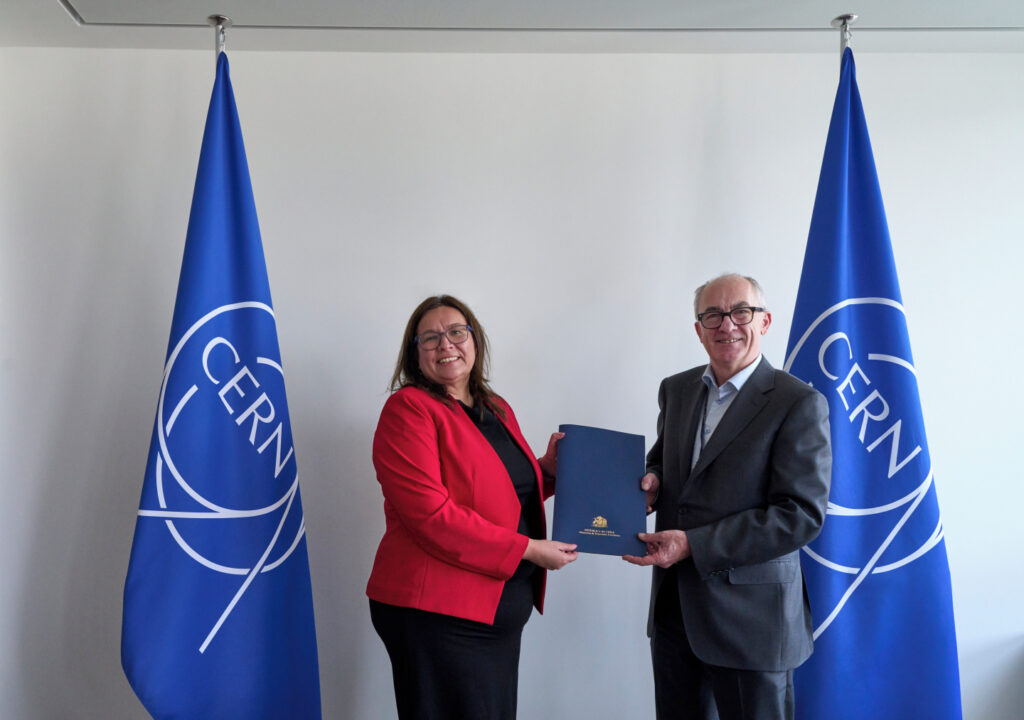
“Notification of Chile’s associate membership in CERN from Claudia Fuentes Julio, Chile’s Permanent Representative to the United Nations and other international organizations in Geneva, to Mark Thomson, Director-General of CERN” (Image: CERN)