
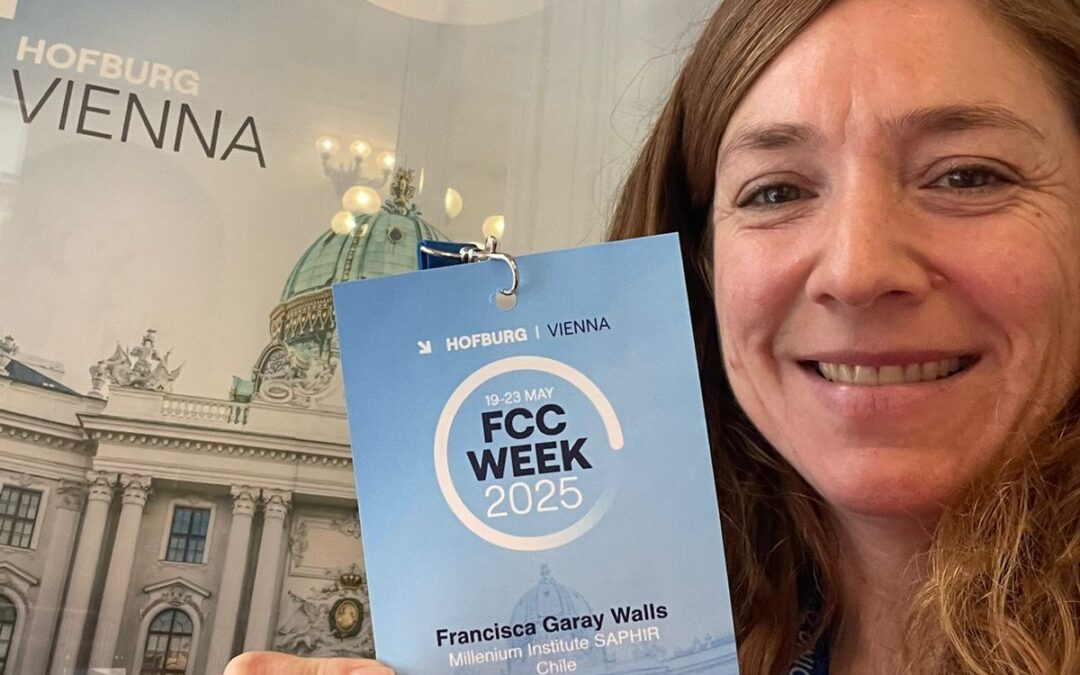
From May 19 to 23, the eleventh edition of the Future Circular Collider Week (FCC Week) will be held at the Vienna Imperial Palace (Wiener Hofburg). eleventh edition of the Future Circular Collider Week (FCC Week), one of the most important international conferences for the development of the next major scientific infrastructure in particle physics.one of the most important international conferences for the development of the next major scientific infrastructure in particle physics.
This year, the conference features the participation of the outstanding Chilean physicist Francisca Garay, alternate director of the Millennium Institute SAPHIR and academic at the Institute of Physics of the Pontificia Universidad Católica de Chile, who joins researchers from around the world to discuss the future of the discipline at a global level.
FCC Week 2025 marks a fundamental milestone, as it is the first collaborative meeting following the delivery of the Future Circular Collider (FCC) Feasibility Study Report in March this year. This document is key to the upcoming update of the European Strategy for Particle Physics, which will define the scientific directions of the continent in the coming years.
The FCC, a project promoted by CERN, is emerging as the successor of the Large Hadron Collider (LHC) and promises to explore new territories in the understanding of matter, energy and the universe. The participation of scientists such as Francisca Garay reflects the growing contribution of the Latin American -and Chilean community in particular- in the debates and developments of frontier physics.
The conference, organized in collaboration with the Institute for High Energy Physics (HEPHY) of the Austrian Academy of Sciences (ÖAW), together with several universities in Vienna, also seeks to consolidate the technical work around the FCC and to strengthen the international networks that will make its design and implementation possible.
For Chile, the presence of representatives at events of this magnitude reaffirms the country's commitment to frontier science and its integration into global discussions on the future of fundamental research.