Particle Physics is the branch of Physics that studies the fundamental components of matter and the interactions between them. Through experiments in particle accelerators, scientists have discovered that all matter is composed of subatomic particles, such as Quarks, Electrons, Neutrinos, etc. In this context, particle physics seeks to understand the deeper structure of the universe and its fundamental laws.
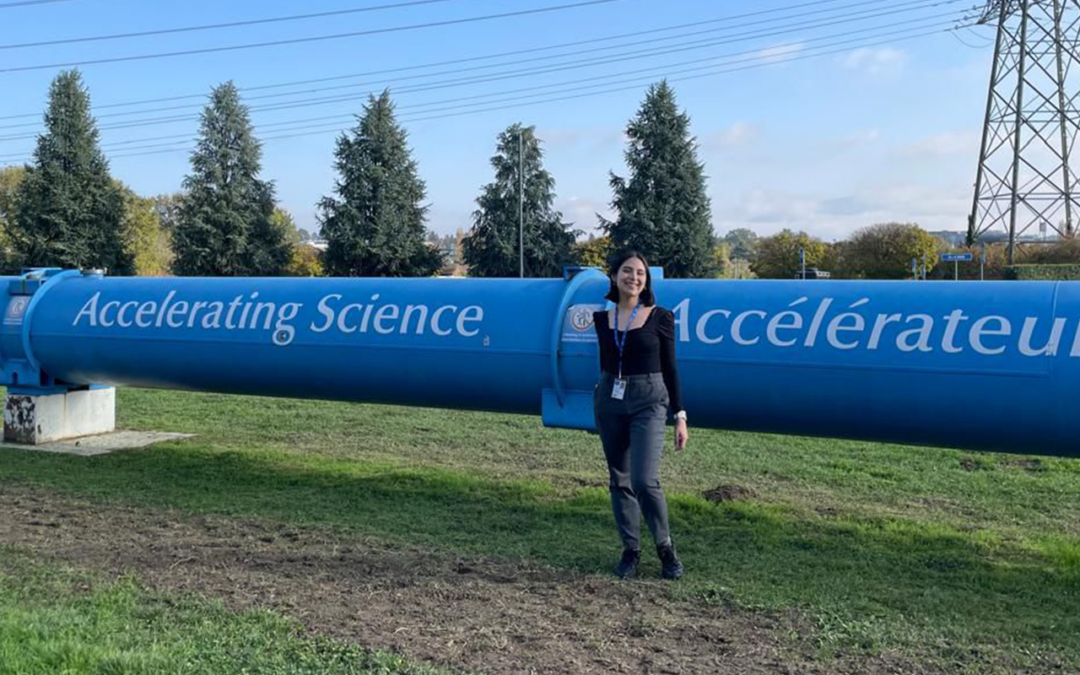
Within this context, Constanza Caceres, a student at the Federico Santa María Technical University (UTFSM) and part of SAPHIR, carried out a research assistantship on the analysis of heavy ion (HI) data alongside Nicolás Viaux, Professor in the Physics Department at UTFSM and SAPHIR researcher, and Sebastián Tapía, Associate Researcher at the DGIIE at UTFSM. During this time, Constanza had the opportunity to travel to CERN to validate data produced by muons in collisions of these ions in the ATLAS experiment.
In this way he applied the knowledge acquired during his internship, particularly in Particle Physics, specifically on Muons and ROOT handling.
Constanza was responsible for ensuring that data collection was carried out optimally. "Initially, data was collected from proton collisions and then from lead ions, since lead collisions form Quark Gluon Plasma (QGP), a state of matter that existed in the early universe. This state can be observed indirectly in the experiment," she explains.
Heavy Ions, as a main source of data
In developing this analysis, protons were an essential source of information, mainly due to one characteristic: quark-gluon plasma does not form there. "This allowed me to compare data from particles passing through this state and thus understand how they interact," adds Constanza.
On the other hand, he says, "It's amazing how people from all over the world come together for the same goal: the advancement of science. I met people from different cultures and perspectives, and I learned a lot, both academically and personally. I am very happy to have had the opportunity to go to CERN and live this experience, thanks to Nicolás and Sebastián, as well as UTFSM, SAPHIR and CERN."
Finally, he mentions that he plans to continue studying areas linked to particle physics. "I aspire to return to CERN in the future, as I greatly value its working environment, which fosters innovation and the development of creative ideas in a collaborative environment," he concludes.