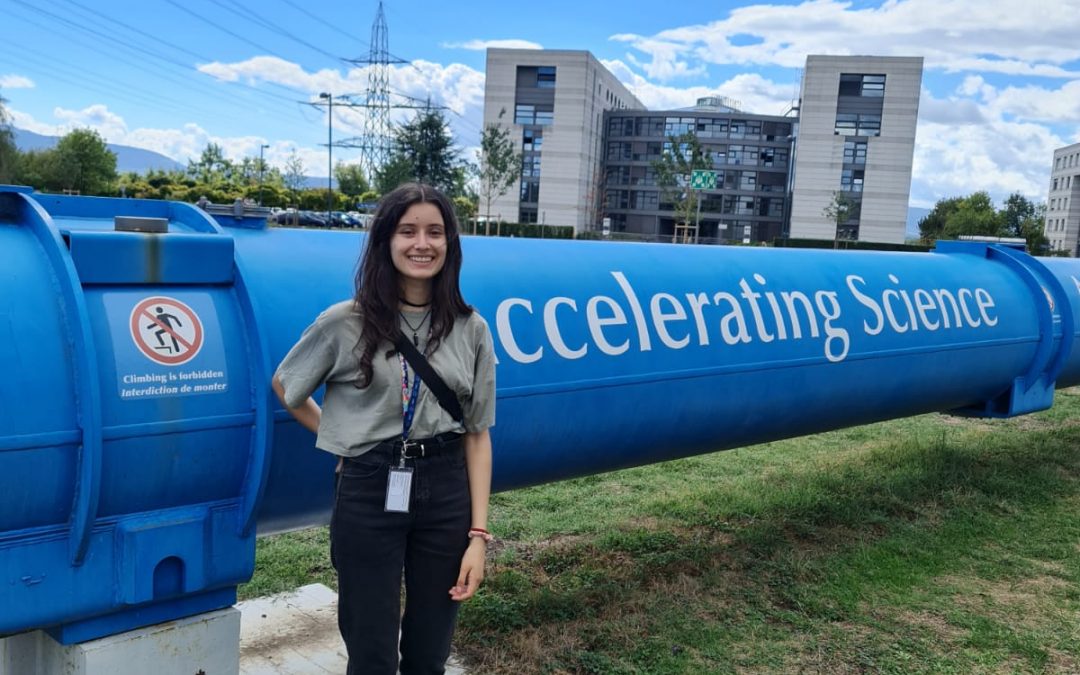
The collaboration between our country and the European Organization for Nuclear Research, better known as CERN CERNhas allowed young undergraduate and graduate students to enter the field of particle physics research.
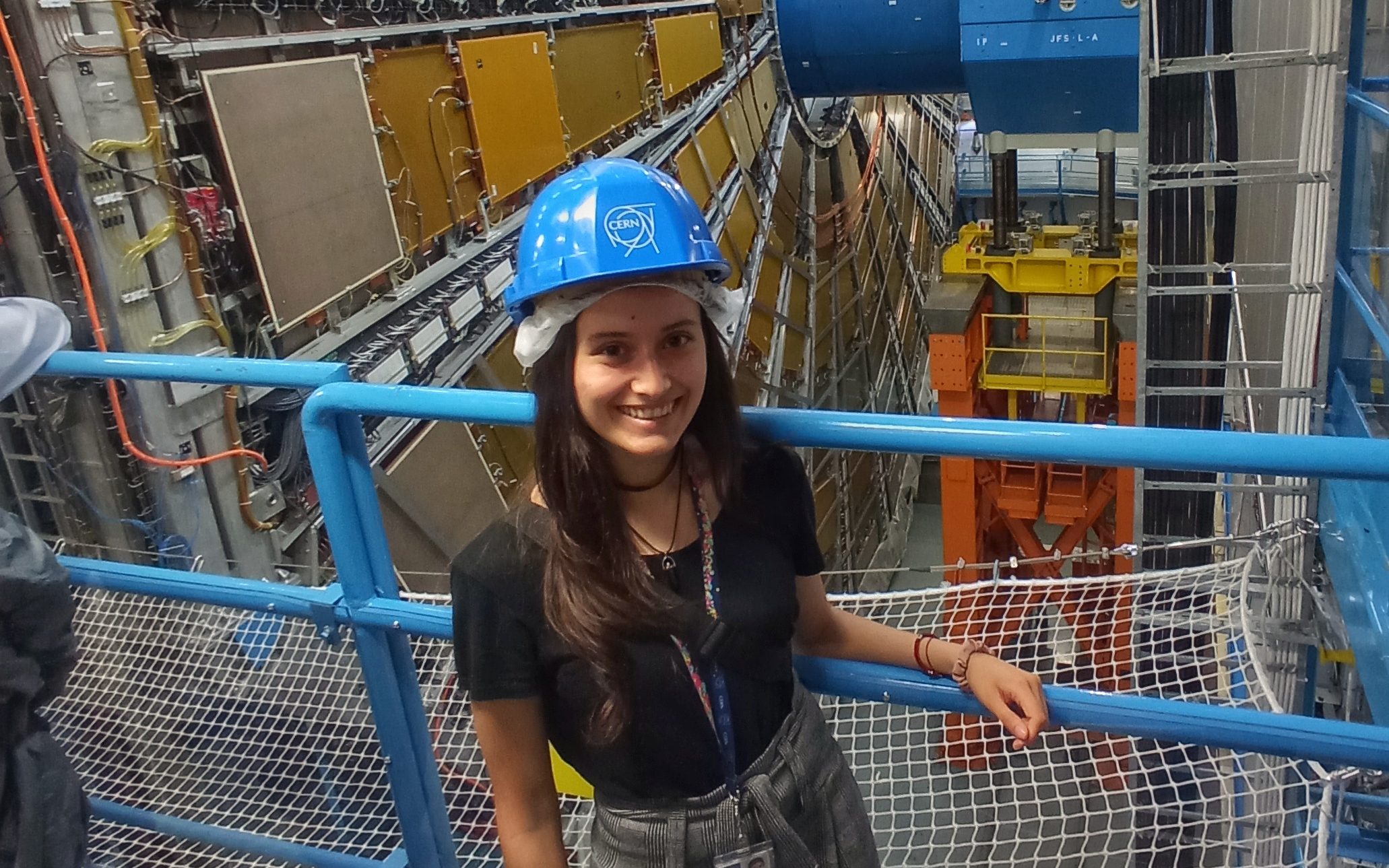
One of these cases was that of Daniella Mora, a student of the Bachelor's Degree in Physics at the Faculty of Exact Sciences of UNAB . Faculty of Exact Sciences at UNAB who, at the end of 2022, had the opportunity to live the experience of working for 2 months in the CERN facilities, specifically, in the NA64 experiment that focuses on the study of dark matter.
During this period, the young woman had to pass several online courses to learn about the procedures and functioning of the organization; after passing the course, she was able to work in the monitoring shifts of the experiment. NA64. Her work consisted of "being in a control room, constantly checking that everything was in good working order: the data acquisition system, the effectiveness of the histograms displayed in real time and keeping a record of the events, among others," she said.
"I also worked together with another student from UNAB with whom I shared shift hours in the experiment and with whom I was able to discuss data analysis of the experiment. I was also able to meet many of the NA64 collaborators, including Mikhail Kirsanov, Renat Dasaev, Laura Molina and Benjamin Banto, who helped me to solve technical and theoretical doubts about the experiment," said Daniella.
"My experience was very enriching because everyone was very willing to teach me, and being able to contemplate their knowledge filled me with motivation to continue studying. In addition, these experiments are interdisciplinary, so you need to work with people from different professions," she said.
Beyond academic training
Although the stay focused on the acquisition of knowledge, Daniella witnessed a key moment for the future training of future researchers, as she witnessed the signing of a collaboration agreement for the support and training of students and researchers from Chile in the areas of particle physics and its respective technology, and the signing of Addendum 1 that encourages and supports the participation of students from Chilean universities in the CERN Summer Student Program.
She was also present at the visit of the team representing our country at the United Nations Office. On that occasion, the young woman participated together with the director of the SAPHIR Millennium Institute, Sergey Kuleshov, in a meeting with the advisor for relations with Latin America at CERN, Salvatore Mele.
What stands out the most about his trip was having been able to put into practice what he learned in his undergraduate studies: "what one studies only theoretically, at least when one is an undergraduate, can be visualized in experiments, and I was able to be part of an important experiment that I was able to observe in person and collaborate in taking data, I was able to interact with the different professionals who have been working on it for years and absorb a small part of their extensive knowledge".
Currently, Daniella is working with Sebastián Olivares, adjunct researcher at the Institute and academic at Universidad Andrés Bello, on her thesis project entitled "Study of the Higgs boson in a muon collider" and plans to apply for a PhD.
We invite you to watch the interview made by the Faculty of Exact Sciences by clicking here.