For two weeks, Santiago was the meeting point for students and specialists from around the world at one of CERN's most prestigious schools, organized in conjunction with the Pontifical Catholic University of Chile and the Millennium Institute SAPHIR, consolidating Chile's position as a key player in international scientific training.
Between January 12 and 23, the Lo Contador Campus of the Pontifical Catholic University of Chile hosted the CERN School of Computing (CSC), the first edition of this renowned international school held in Latin America. Organized by CERN, the Pontifical Catholic University of Chile, and the Millennium Institute SAPHIR, the event brought together students from various disciplines, nationalities, and backgrounds for an intensive training program in scientific computing, data analysis, and enabling technologies for contemporary research.
The establishment of this school in Chile marks a milestone for the national and regional scientific ecosystem, not only because of the academic excellence of the program, but also because of its capacity to generate networks, community, and international collaboration. For SAPHIR, having been part of the organization of this school represents much more than the success of an academic agenda: it is a concrete demonstration of institutional capacity, coordination, and long-term vision. Chile can host events of high international standard, create conditions for the exchange of knowledge, and act as a bridge between the local ecosystem and the world's major laboratories.
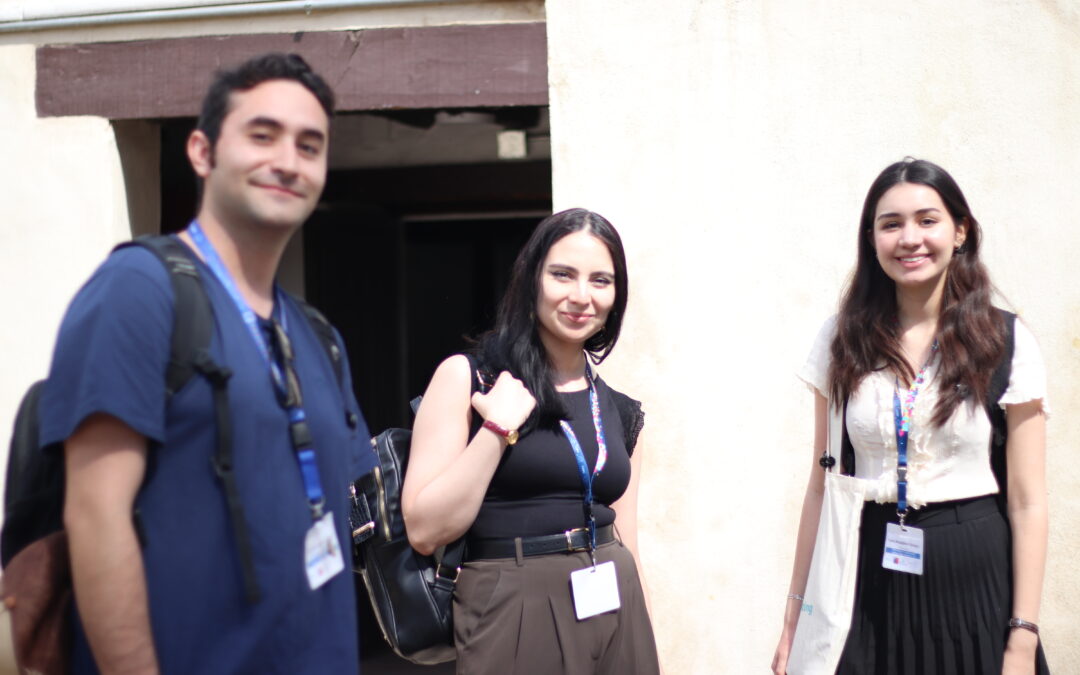
The students were at the heart of the experience. The diversity of disciplines was one of the aspects most valued by the participants. This was expressed by Josef Ruzicka, a student at the Technological Institute of Costa Rica, who highlighted that "at the academic level, I was very surprised that, even though all the students came from different areas of study and research projects, the course managed to leverage that as a strength. Each student was able to contribute from their own experience, and we all learned from each other.". Along the same lines, he emphasized that "the course topics were very suitable for subsequent application in our research,", highlighting the relevance and practical application of the content.
Since his training in computer science, Ruzicka has particularly valued the impact of the faculty's work, noting that "the software development tools presented by Professor Arturo Sánchez will greatly streamline my work process.". He also highlighted Helena Brandao's contributions in physics, the Monte Carlo simulations developed together with Jaime Romero, and the probability and statistics content taught by Toni Sculac, which he described as key to complementing his disciplinary training.
A similar experience was shared by Andrea De La Peña Castro, a participant from Costa Rica and a professional at Boston Scientific, who particularly appreciated the comprehensive nature of the school. For her, one of the greatest privileges was "the opportunity to devote myself 100% solely to learning. Every day we sat in the classroom and enjoyed the passion that united us all: learning about science. It was a space designed for growth, an opportunity that you don't get every day.". Andrea also highlighted the richness of the interdisciplinary exchange, noting that "learning from experts in different areas, from teachers to our own classmates, was a real privilege.".
In terms of content, Andrea emphasized the value of exploring new areas of knowledge: "Everything related to computing was very meaningful to me. Navigating so many topics allowed me to identify those that most interest me today, such as the database section, which sparked a curiosity that I will continue to cultivate.". These experiences reflect how the school not only strengthened technical skills, but also opened up new professional and academic prospects.
From a local perspective, Daniella Mora, a Chilean doctoral student at the Millennium Institute SAPHIR, particularly highlighted the role of the organization and the human atmosphere that was generated during the school. As she pointed out, "I had never participated in a school where the organizers were so attentive to proposing extracurricular activities, accompanying us to them, and even participating in them; I think that was what I valued most about this school and what made it so special.". On the academic level, Daniella highlighted "the quality of the lecturers, because they were all very willing to explain things, even after class.".
In terms of content, he particularly highlighted Jaime Romero's Monte Carlo classes, due to their direct relevance to his research topic, as well as Toni Sculac's data analysis sessions, "for their content and his way of explaining, which was very engaging and really made you question the content.". He also appreciated the data technologies classes taught by Alberto Pace and the database classes with Andrzej Nowicki, areas that, as he commented, "he had never studied before and had very interesting concepts to learn.".
Beyond the academic sphere, testimonies agree in highlighting the human and cultural component of the experience. For Josef Ruzicka, one of the greatest values of the school was meeting people who transcended the academic: "We were fortunate to meet wonderful people who will be our friends for the rest of our lives.". Andrea De La Peña highlighted her experience in Chile, noting that "I am leaving fascinated by Santiago and its people. Learning about their culture, history, and way of life was invaluable.", adding that it was especially meaningful to see that "in Latin America there are organizations such as the SAPHIR Millennium Institute, with such dedication to science and professionals of the highest level.".
This milestone also deepens the link between SAPHIR and CERN, reaffirming the value of international cooperation as a driver of knowledge transfer, standards, and scientific culture. In this context, the excellent coordination with the CERN organizing team was highlighted, in particular Alberto Pace, Kristina Gunne, and Andrzej Nowicki, whose commitment and experience were fundamental to the success of this edition. Likewise, gratitude was expressed for the backing of the Ministry of Science, Technology, Knowledge, and Innovation, and the support of the Pontifical Catholic University of Chile, which opened its doors to turn the event into a true meeting point for ideas, collaboration, and the future.
Completing the CERN School of Computing in Chile is, above all, an invitation to look further ahead. A country's scientific and technological development is not built solely on infrastructure or projects, but also—and decisively—on communities, coordination, and talent training. The experience gained during these two weeks confirms that when an ecosystem is articulated, the impact is real and lasting.