
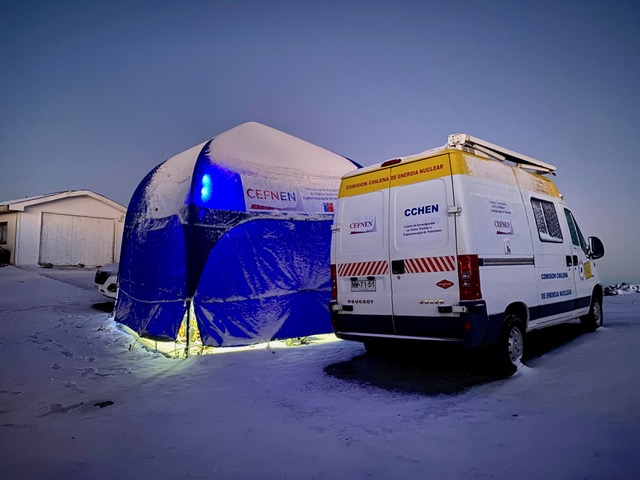
High in northern Chile, where the sky is so clear that it seems to magnify the universe, something invisible yet constant is happening: a shower of particles from space is passing through Earth’s atmosphere. These are cosmic rays, messengers of distant phenomena, which, upon colliding with the air, generate a cascade of secondary particles, including neutrons. For decades, scientists have tried to interpret this signal to better understand the behavior of the Sun and the space near Earth, but there is a problem: Earth itself can distort the message. At the Las Campanas Observatory, a team from the Center for Nuclear Physics and Neutron Spectroscopy (CEFNEN) decided to tackle this challenge with a fresh perspective.
Traditional instruments, known as neutron monitors, have been essential for studying cosmic radiation. However, they function like counters: they record how many neutrons arrive, but do not provide much detail about them. “A traditional neutron monitor cannot distinguish whether a variation in its count is due to a change in solar activity or simply because it snowed overnight,” explains physicist Francisco Molina, a researcher at the Center for Nuclear Physics and Neutron Spectroscopy (CEFNEN) of the Chilean Nuclear Energy Commission (CCHEN) and an associate of the SAPHIR Millennium Institute. Because yes: something as ordinary as snow or soil moisture can alter what the detectors record.
To solve this problem, the team deployed a portable spectrometer capable of doing something different: not just counting neutrons, but observing them in detail, based on their energy. “Our spectrometer measures the full energy spectrum… In short, it ‘sees’ more, and in greater detail, than a conventional monitor.” And that ability to ‘see more’ makes all the difference, because low-energy neutrons are particularly sensitive to their surroundings.
During the measurement campaign, something unexpected happened: a snowfall blanketed the observatory. Far from interrupting the experiment, it enriched it. The researchers were able to observe how the signal changed in real time: some neutron counts increased, others decreased, and the overall pattern shifted, revealing the impact of the local environment.
The key finding of the study was the identification of a relationship between different types of neutrons that serves as an indicator of the water content in the environment. “The spectrometer acts as a ‘neutron environmental thermometer,’” notes Francisco Molina. This would make it possible to distinguish between what comes from space and what occurs on Earth, correcting the measurements and making them much more accurate.
The implications of this breakthrough extend beyond basic research. “This would not only improve the reliability of global networks, but also open the door to applications in environmental monitoring,” adds the researcher. From estimating soil moisture to detecting snow in remote areas, the same technology could be used to understand both the universe and the planet.
Part of the success of this work also has to do with the region. “Chile is an extraordinary natural laboratory,” says Dr. Molina. That diversity makes it possible to study how different landscapes affect cosmic radiation, generating unique insights. Ultimately, this breakthrough is about learning to correctly interpret the information coming from space, distinguishing between what happens in the universe and what happens here on Earth.