
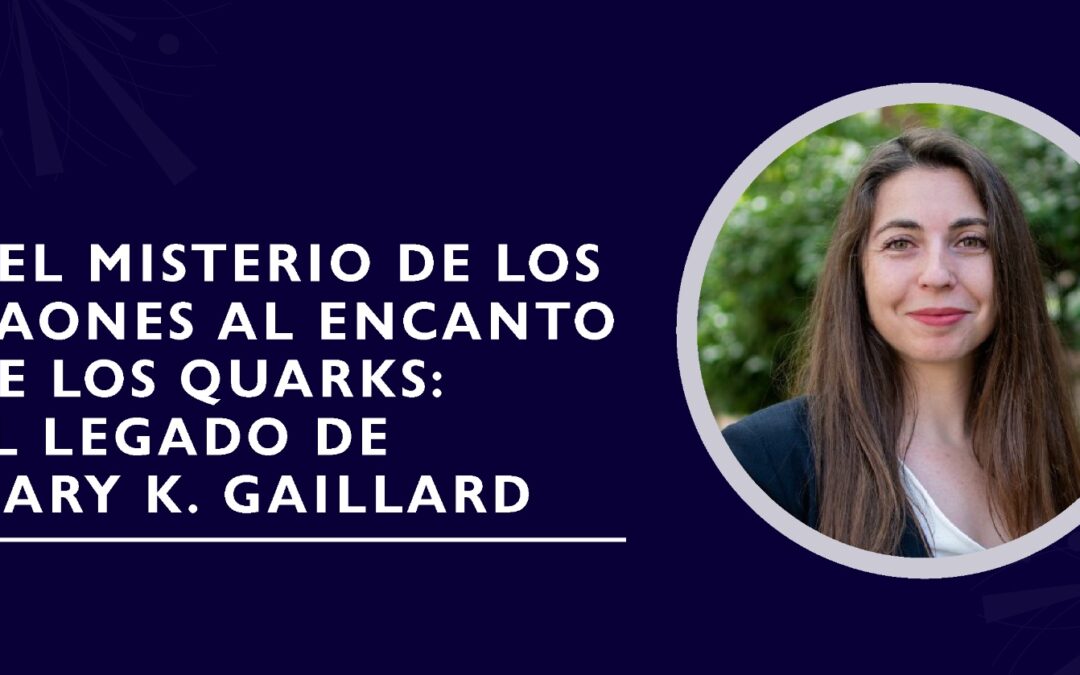
A few weeks ago I learned of the death -in May of this year and at the age of 86- of Mary K. Gaillard, a titan of theoretical particle physics, that which describes and predicts what happens to matter inside atoms and what things exist there. Today we understand that there is a force that holds nuclei together, and another, that disintegrates them. And these forces involve the exchange of different elementary particles. These phenomena are described by the so-called Standard Model of Particle Physics. But consolidating this knowledge has required hundreds of contributions from many scientists. Mary K. Gaillard was a key scientist in understanding the properties of the most basic constituents of nuclei: the so-called quarks. And of one in particular, a charming one, indeed. The so-called charm (c) quark (or "charm" quark).
We have known about potential quarks since the 1960s from physicists George Zweig and Murray Gell-Man, who independently predicted quarks to explain the different quantum numbers (such as electric charge) of particles composed of quarks. Today we know that there are six types of quarks in total. But Murray's original model had only three (the three we know today are the lightest): the so-called up (u), down (d) and strange (s). It took more than a decade to convince us that there was a fourth, more massive quark, the charm.
As the existence of quarks as real particles and not only as mathematical constructs was consolidated, there was some resistance to these particles having fractional electric charges. This is because one has never been observed. Today we understand that quarks always go together (they are confined to the nuclei of atoms; in fact, no single quark has ever been measured). Protons, for example, are made of three quarks, two up-type and one down-type. The fractional electric charges of the quarks within the proton combine to give a total positive electric charge (of +1).
Mary K. Gaillard, overcoming resistance, began to study strange particles called kaons. They were literally called strange particles, since their pairwise production implied a new quantum number called strangeness. Kaons are composed of a strange quark and an anti-down quark, giving zero net electric charge for neutral kaons. Neutral kaons can then disintegrate into other elementary particles, such as a muon (with charge -1) and an anti-muon (with charge +1, the antiparticle of the muon), respecting the conservation of electric charge in particle interactions.
Mary K. Gaillard became a world reference in kaon physics. The theory of the time predicted that the decay process of neutral kaons to muons and anti-muons occurred with a small probability only if there was a fourth charm quark, having the same electric charge as the up quark. And this probability depended on the mass of the charm, but also on the mass of the up quark. This is because quarks do not interact only with each other to form protons or kaons. They can also interact by exchanging other massive particles called W bosons. And these can also transform or decay to different types of quarks. So how often this decay occurs depends on both the mass of the up and the mass of the charm. Experimentally it was measured that this decay was effectively suppressed.
But, Mary K. Gaillard dared to ask the following question: Why is the decay of a neutral kaon to two photons, if governed by the same theory, not equally suppressed in experiments? This decay also preserves the electric charge of the quarks, since the photon has no electric charge. And, if charm exists, it was theoretically expected that its probability would also be small, comparable to the decay of kaons to muons and anti-muons. But it was larger. This was worrisome, as it could severely challenge the theory construction of the time, which relied heavily on the predictions of this suppression mechanism (known today as the "GIM mechanism" in particle physics).
To solve this mystery in the decays of kaons and, moreover, to be convinced that the theoretical bases of the time were not broken, leads to an arduous and systematic work of Mary K. Gaillard in the study of the physics of kaons with charms. Work that particularly at that time of particle physics depended indirectly on experimental observations, so that one had to be very alert to each new result.
Gaillard's work explains why the decay of kaons to muon and anti-muon is extremely suppressed in nature and why that to two photons is not. In the first case, the decay depends on the difference in masses between the up and the charm. This difference must have been much smaller than the mass of the W boson (which was sneaking into the decay), and which at the time was assumed (but not yet known) to have a mass much larger than the mass of the proton. The study of the second decay leads to the understanding that the mass of the up boson must be much smaller than the mass of the charm. Mary K. Gaillard (together with physicists Benjamin Lee and Johnatan Rosner) calculated in 1975 this difference, concluding that the mass of the charm should be about 1.5 GeV (in energy units). That is, Mary K. Gaillard predicted the value of the charm quark mass, three months before the charm was discovered!
In this study of kaon decays, it is the difference between the masses of the particles that is important, and not only the specific value of each mass in isolation, but how different they are from each other. This is very striking to me; the background explanation is elegant. To make an analogy, it is as if nature knows that what really shapes the melody of a song (frequency of decays) depends on the distance between the notes, and not on each note (mass) separately.
Gaillard was able to see what others of his contemporaries did not see, to ask questions that others did not dare, and to study strange phenomena and particles that not everyone was interested in. Later in his career, his contributions included predicting the mass of a new quark, the bottom (b) or beauty quark with M.S. Chanowitz and J. Ellis, as well as identifying with J. Ellis and G. Ross that a gluon - the particle responsible for mediating strong nuclear interactions between quarks - could be seen as a three-jet or particle beam event in electron-positron collisions. This was indeed how the gluon was subsequently discovered.
In her autobiography, Mary K. Gaillard summarizes her numerous discoveries by honestly detailing their contexts. This one is entitled "A Singularly Unfeminine Profession" published in 2015. The title stems from her hearing those words from a neighbor's mouth in response to her saying she wanted to study physics. I came across her book in the CERN bookstore in 2018. The title called to me in an instant. I read it again before writing these letters. The legacy of Mary K. Gaillard transcends even beyond her science. She reminds us that passions do not discriminate: they choose us.
Source: Cooperativa.cl