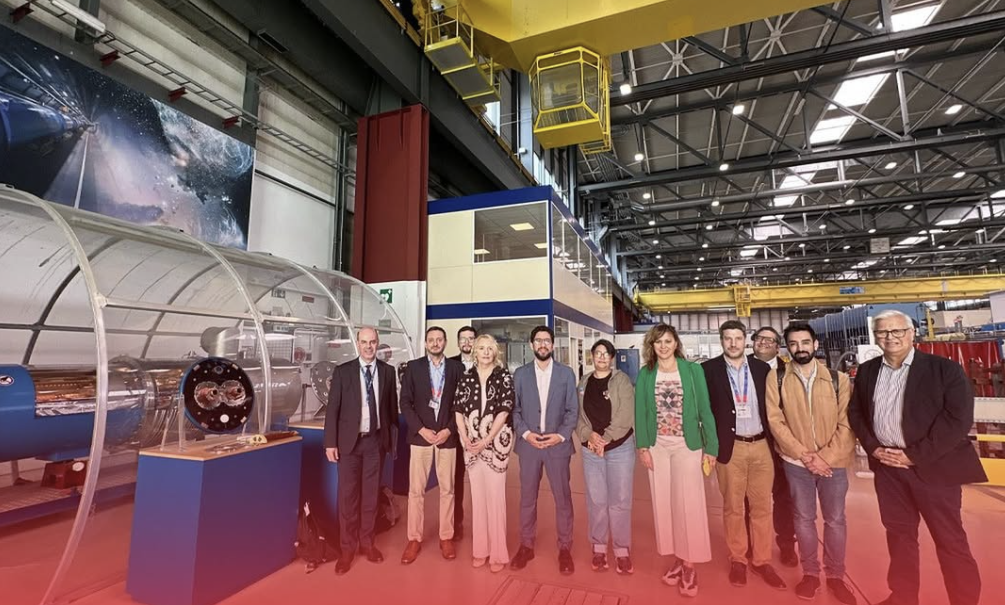
Last Wednesday, June 11, 2025, an official Chilean delegation headed by the Minister of Labor and Social Welfare, Dr. Giorgio Boccardo, paid an institutional visit to CERN, the European particle physics laboratory, located in Geneva, Switzerland. The delegation was composed of senators, union representatives, ministerial advisors and diplomats, and was received by CERN authorities, including Charlotte Warakaulle, Director of International Relations, and Emmanuel Tsesmelis, Head of Relations with Associated and Non-Member States.
As part of the program, the delegation toured key facilities such as the CERN Data Center, the LHC superconducting magnet assembly hall and the ATLAS experiment interaction point. At this last point, they were received by the Chilean team currently active in the ATLAS collaboration: Dr. Nicolás Viaux, researcher at the Millennium Institute SAPHIR and academic at the Universidad Técnica Federico Santa María; Constanza Valdivieso, Astrophysics student at the UTFSM; and Carlos Flores, technician at the SAPHIR Institute at the Universidad Andrés Bello. Their presence represents the concrete contribution of young Chilean talents and researchers to scientific experiments on a global scale.
This visit is framed in the context of Chile's recent entry as an Associate Member State of CERN, a historic milestone that consolidates decades of scientific collaboration and opens new opportunities for technological development, human capital formation and active participation in the most advanced experiments in fundamental physics. Thanks to this new status, the country strengthens its capacity for advocacy and access within the CERN ecosystem, both in research and innovation.
The Millennium Institute SAPHIR, funded by the National Agency for Research and Development (ANID), has played a key role in this process. Through the articulation of researchers from several Chilean universities, SAPHIR promotes theoretical and experimental research in particle physics, and maintains a permanent collaboration with experiments such as ATLAS, NA64, SND@LHC and others. Its active presence at CERN, together with the educational work with young students, positions the Institute as a strategic actor in Chilean science with international projection.