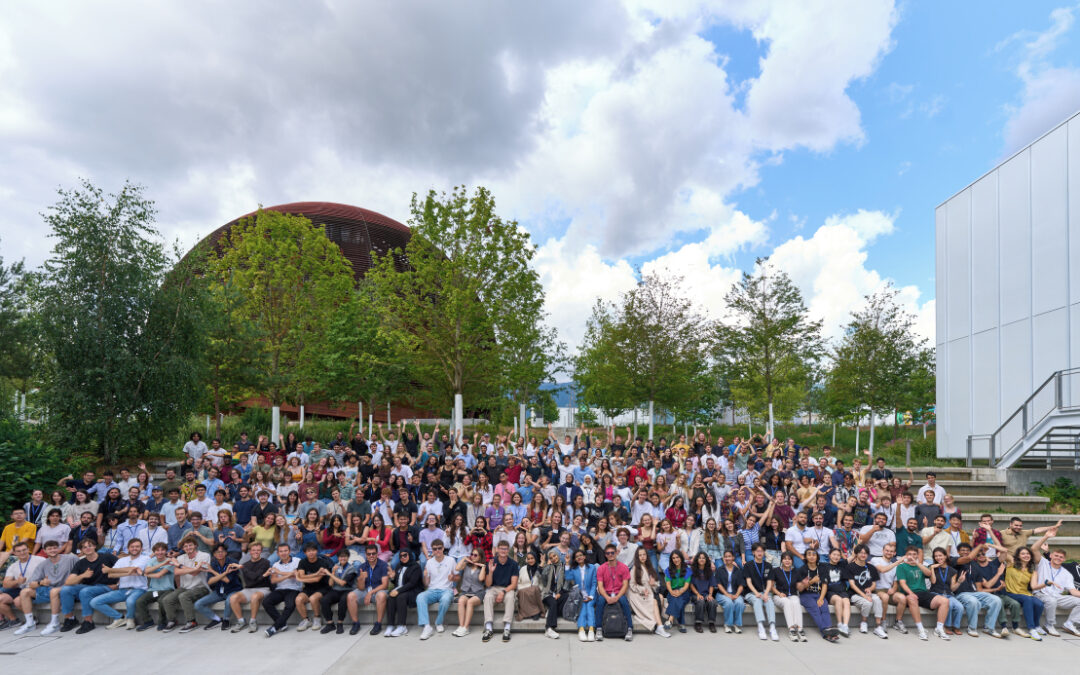
Since its beginnings in 1962, when Victor Weisskopf promoted an initiative for young university students to participate in research projects during their summer vacations, CERN's Summer Student Program has become one of the most prestigious educational opportunities in the world of particle physics, engineering and applied sciences. In its first version, 70 students participated, marking the beginning of a space that over the years would become a true international platform for learning, collaboration and academic projection.
Today, more than six decades later, this program brings together every year hundreds of undergraduate and master's students from more than 100 countries, who for 8 to 13 weeks work on cutting-edge projects, attend specialized classes taught by leading researchers, visit unique facilities such as accelerators and detectors, and share their results in academic sessions. It is an experience that not only boosts individual careers, but also contributes to strengthening ties between universities, research centers and scientific communities around the world.
The role of SAPHIR and Chilean participation
The Millennium Institute SAPHIR, dedicated to the study of subatomic physics and scientific collaboration at the Large Hadron Collider (LHC), has been a key player in bringing Chilean students to this international training experience. Throughout different editions, SAPHIR has promoted and supported the participation of young researchers, strengthening the link between Chile and CERN.
In the most recent version of the CERN Summer School, three students linked to SAPHIR participated: Vicente Valenzuela Osses, from the Pontificia Universidad Católica de Chile; Constanza Valdivieso Castillo, from the Universidad Técnica Federico Santa María; and Vicente Millar Bravo, from the Universidad Andrés Bello. Their presence in this instance not only represents an individual academic achievement, but also a milestone for Chilean science, demonstrating the capacity of our universities and research centers to train young people who actively contribute to the most important physics laboratory in the world.
The current context further reinforces this projection. With the recent appointment of Chile as an Associate Member State of CERN, new opportunities are opening up to expand and consolidate this type of collaboration, not only in the Summer School, but also in other scientific, technological and educational initiatives. This milestone will strengthen the presence of Chilean students, researchers and academics at the frontier of knowledge, enhancing the integration of our country in one of the most influential scientific communities worldwide.
SAPHIR highlights the importance of this moment: "The participation of our students in the CERN Summer School is a clear example of how international collaboration impacts the training of new generations of scientists in Chile. With the incorporation of our country as an Associate Member State of CERN, we will be able to further expand these opportunities and ensure that young talents continue to play an active role in projects of global scope. This is a strategic step that not only strengthens Chilean science, but also projects it to the highest international level", says Felipe Olivares León, Executive Director of SAPHIR.