
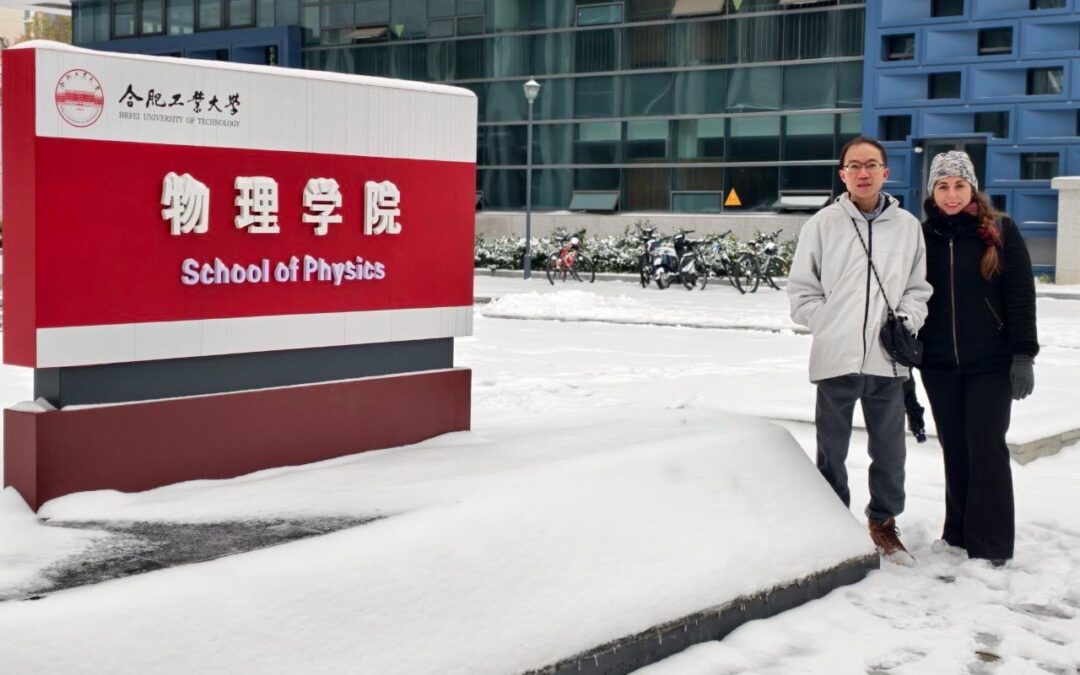
The researcher at the Millennium Institute SAPHIR and academic at the Institute of Physics at the Pontifical Catholic University of Chile, Giovanna Cottin, continues to consolidate the international presence of Chilean research in particle physics and dark matter following an intense academic agenda recently carried out in the United Arab Emirates and Asia, where she presented cutting-edge advances and strengthened strategic collaborations with leading research centers.
Between January 13 and 15, Dr. Cottin participated in the High Energy, Cosmology, and Astroparticle Physics Conference, held at New York University Abu Dhabi. The meeting, which was closed and by invitation only, was organized by Marta Losada and Nicolás Bernal, who extended the invitation to the Chilean researcher. The event brought together leading theoretical physicists currently affiliated with NYU Abu Dhabi, including Fernando Quevedo and Gian Giudice.
In this context, the researcher presented the talk "Dark Sectors at the Collider Lifetime Frontier", where she presented recent results on the theoretical connections between dark sector models and predictions of long-lived particles. Her presentation also addressed projections for the identification of these signals in current and future colliders, such as the Large Hadron Collider and the Future Circular Collider. The talk placed special emphasis on a recent publication developed together with Nicolás Bernal, her student Manuel López, and SAPHIR researcher Bastián Díaz, reinforcing the contribution of the Chilean core to this frontier field of research.
During the workshop, key topics such as inflation, dark matter models, gravitational waves, extra dimensions, and supersymmetry were discussed, with a common focus on understanding the nature of dark matter. From new production mechanisms in the early universe to the interpretation of recent experimental results, the event allowed for an in-depth dialogue between theory and observation. For Dr. Cottin, this experience was particularly enriching, given her current scientific interest in the links between dark matter and long-lived particles.
After her stay in Abu Dhabi, the researcher traveled to Asia to visit her long-time collaborator Zeren Simon Wang, an academic at Hefei University of Technology, with whom she has been actively collaborating for five years. Both researchers work primarily on the phenomenology of long-lived neutrinos and neutralinos, a line of research that has already resulted in seven joint scientific publications. The visit was particularly significant, as it was the first face-to-face meeting since the end of 2019.
During this stay, a new collaborative project was launched involving PhD student Paulo Areyuna and, once again, SAPHIR researcher Bastián Díaz, focusing on dark matter models with long-lived particle signals. Yu Zhang also joined this effort. Yu Zhang, an academic from Hefei University of Technology, broadening the international scope of the work. The experience of the Chinese researchers will be key to improving the quality of theoretical predictions, especially in the study of displaced detectors.
As part of this academic agenda in China, Dr. Cottin gave a seminar at the School of Physics at Hefei University of Technology, entitled "Probing Dark Sectors at the Collider Lifetime Frontier". In this presentation, she addressed how the existence of long-lived particles could manifest itself through unconventional experimental signatures in high-energy colliders, requiring new strategies for searching and interpreting data.
With this intense international activity, Dr. Giovanna Cottin not only strengthens her own lines of research, but also contributes significantly to the positioning of the Millennium Institute SAPHIR as a major player in global research on physics beyond the Standard Model and the understanding of the nature of dark matter.