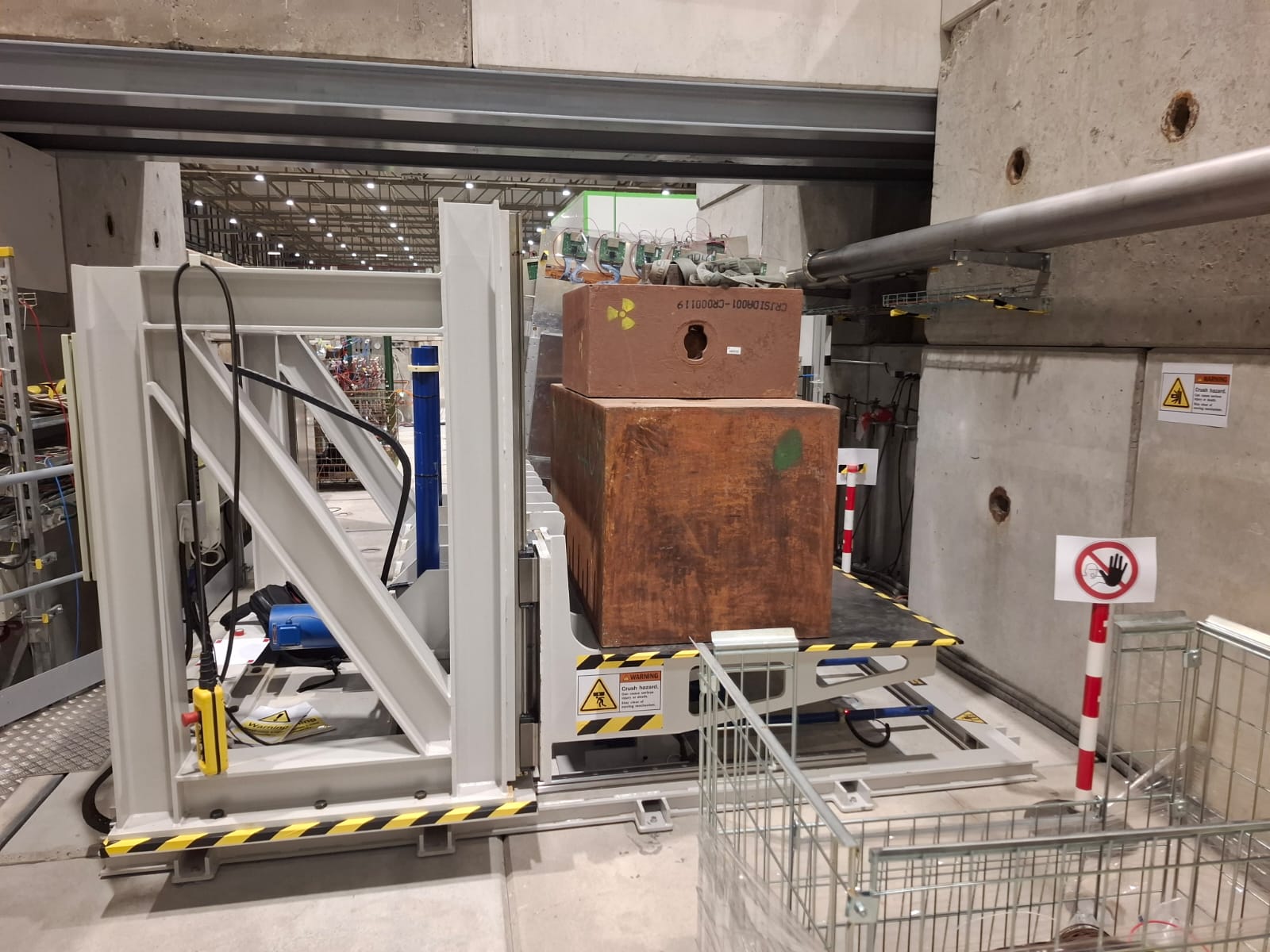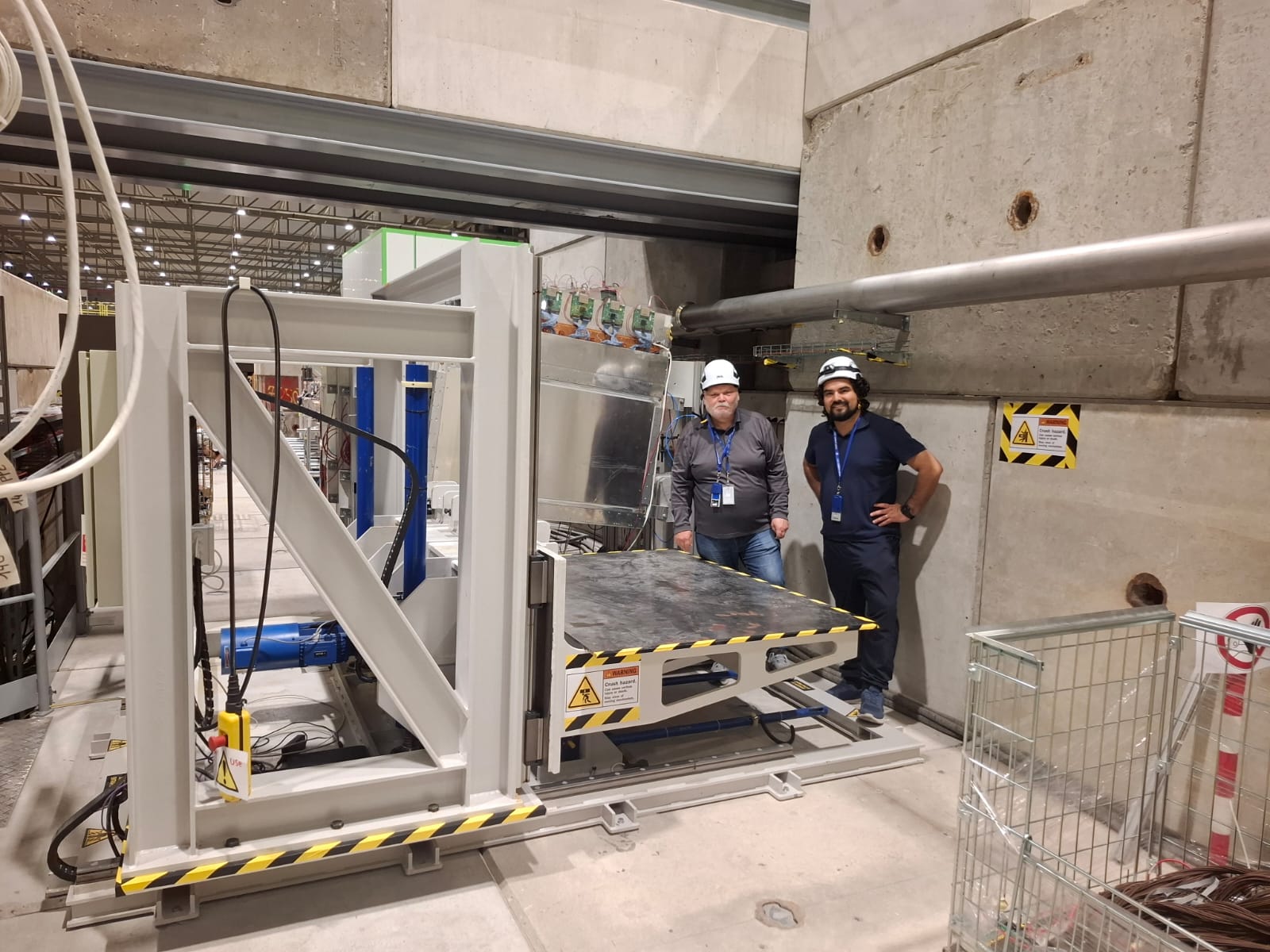
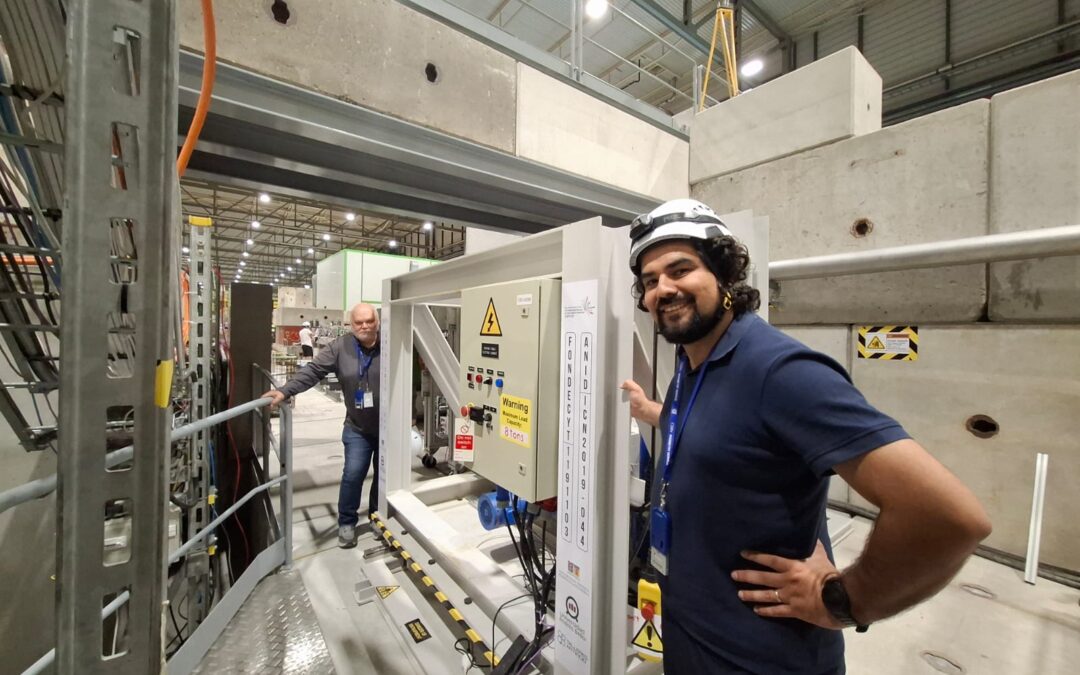
In CERN's subway laboratories, where the deepest mysteries of matter are explored, there is also room for Chilean talent and engineering. A team from the Millennium Institute SAPHIR actively participates in the NA-64 experiment, collaborating in the development of a sophisticated moving table: a platform specially designed to lift and move calorimeters of up to 8 tons, a key piece in the operation of this particle physics experiment.
Recently, this structure - designed and manufactured entirely in Chile - reached a key milestone: it successfully passed its most demanding load test, the final step in CERN's technical certification process.
"The machine was subjected to stress and pushed to its operating limits, but kept running stably and smoothly," explains Carlos Flores, technical specialist at CTEPP UNAB and SAPHIR. "This certifies that it is capable of supporting a nominal load of up to 8 tons, quite a feat for the national industry, since this would be the first machine of its kind to be manufactured in Chile and to be installed at CERN."
The relevance of the achievement is even greater if the international context is considered. "Currently, at CERN there are German, French and Italian machines that perform similar tasks, but with lower load capacities or higher prices," comments Flores. "One of the challenges of the project was for the Chilean machine to be sufficiently competitive in terms of cost, but without sacrificing robustness or performance."
To achieve this balance between efficiency, strength and cost, collaboration between academic institutions and the private sector was key. "A lot of design and collaboration work was carried out between the Andrés Bello and Federico Santa María universities, and the Chilean engineering company Talleres Artificio, which was in charge of manufacturing and assembling the machine," he explains.
The success of the test not only guarantees the operability of the table in the demanding environment of CERN, but also represents a concrete recognition of national technological development. "Passing this final test makes us enormously proud, because it validates the hard work done by Chilean physicists, engineers and technicians in the long process of design, simulation and assembly of this tremendous machine."
Beyond the technical result, there is a deeply significant human dimension to this story. "Personally, I am very excited to see the fruit of these last three years of work with a team of Chileans who gave their all for an idea that seemed unattainable, but that today is a reality: Chile can manufacture machinery capable of competing on a level playing field with European industry."
With this contribution, the SAPHIR Millennium Institute not only reaffirms its commitment to frontier research, but also strengthens Chile's role as an actor capable of developing advanced technological solutions in the world's most demanding scientific scenarios.