
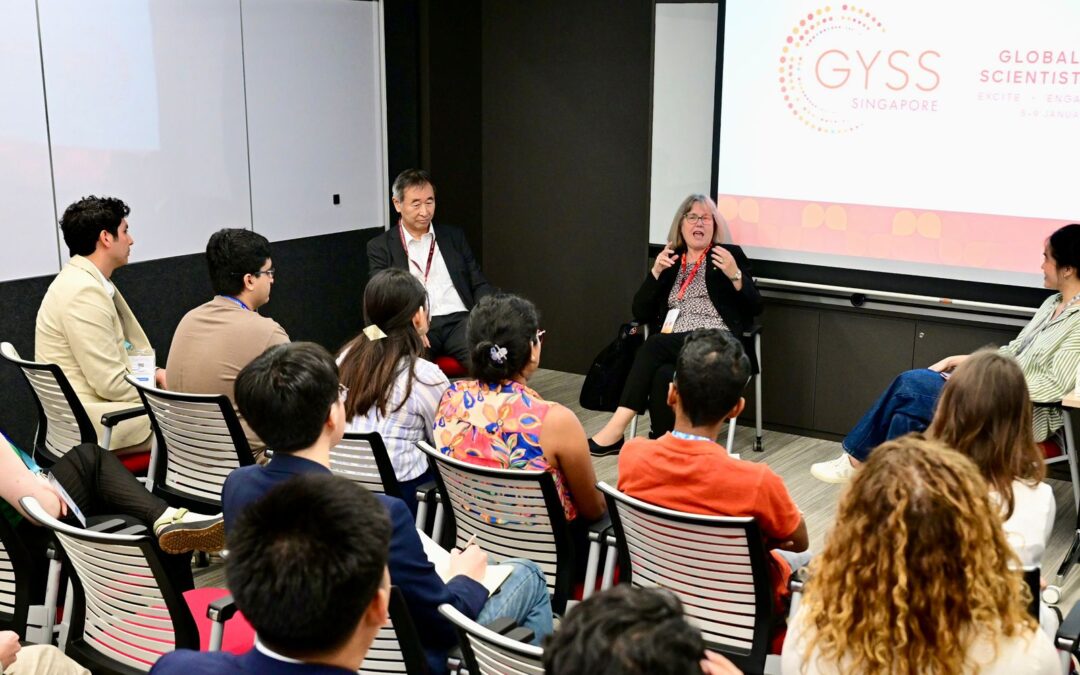
Photo: GYSS SINGAPORE 2026
Marco Ayala, postdoctoral researcher at the Millennium Institute SAPHIR, participated in a fireside chat with Nobel Prize winners in Physics Takaaki Kajita and Donna Strickland during the Global Young Scientists Summit 2026 in Singapore, reflecting on scientific motivation, validation of discoveries, and the great future challenges of particle physics.
During the first days of January 2026, Marco Ayala, a postdoctoral researcher at the Millennium Institute SAPHIR, participated in a fireside chat with Nobel Prize winners in Physics as part of the Global Young Scientists Summit (GYSS) held in Singapore. The event brought together outstanding young scientists with world leaders in science, promoting close dialogue on cutting-edge research and scientific career development.
In this context, Ayala held talks with Takaaki Kajita, awarded for the discovery of neutrino oscillations, and with Donna Strickland, Nobel Prize winner for the development of ultrashort pulse lasers. Beyond the technical aspects, the dialogue addressed the philosophy of scientific work and the deep motivations that guide research.
"The conversation was very close and informal, and rather than focusing solely on technical results, it led us to reflect on how we approach research, what motivates us, and how we decide where to direct our scientific work," Ayala notes.
One of the central themes was the scientific and human impact of major discoveries. "Kajita reminded us that neutrino oscillations required more than ten years of work before the community accepted such a disruptive result," explains the researcher. "This reinforces the idea that frontier science requires perseverance, constant validation, and a great deal of conviction."
In relation to career prospects, Ayala highlights the inspiring nature of the meeting. "It is very motivating to talk to someone whose career culminated in a Nobel Prize and to see that today he is thinking about the big questions that will mark the next ten years, such as understanding what dark matter is," he says. In this regard, he emphasizes that Kajita's participation in new Japanese projects related to gravitational waves and dark matter is directly connected to the lines of research being developed by SAPHIR at CERN, particularly in experiments such as NA64 and SND@LHC.
The fireside chat also provided an opportunity to reflect on the current challenges facing particle physics. "There is no sure path that tells us where a new discovery will appear," says Ayala. "Recent examples, such as the Fermilab results that strongly disfavor light sterile neutrinos, show that science advances by revising hypotheses over and over again, even when years of work have been invested."
From his position at SAPHIR and within the CERN environment, the researcher highlights the importance of exploring new directions. "Part of our job is to dare to go beyond what has already been done, explore new ideas, and accept that it is a long and uncertain journey," he says. "Staying motivated is key, and that can only be achieved by choosing topics that really interest us, because we spend years and years dedicated to the same line of research."
The participation of researchers from the Millennium Institute SAPHIR in events such as GYSS reflects the institute's position on the international scientific stage and its commitment to academic excellence, advanced training, and Chile's contribution to the great open questions of contemporary science.