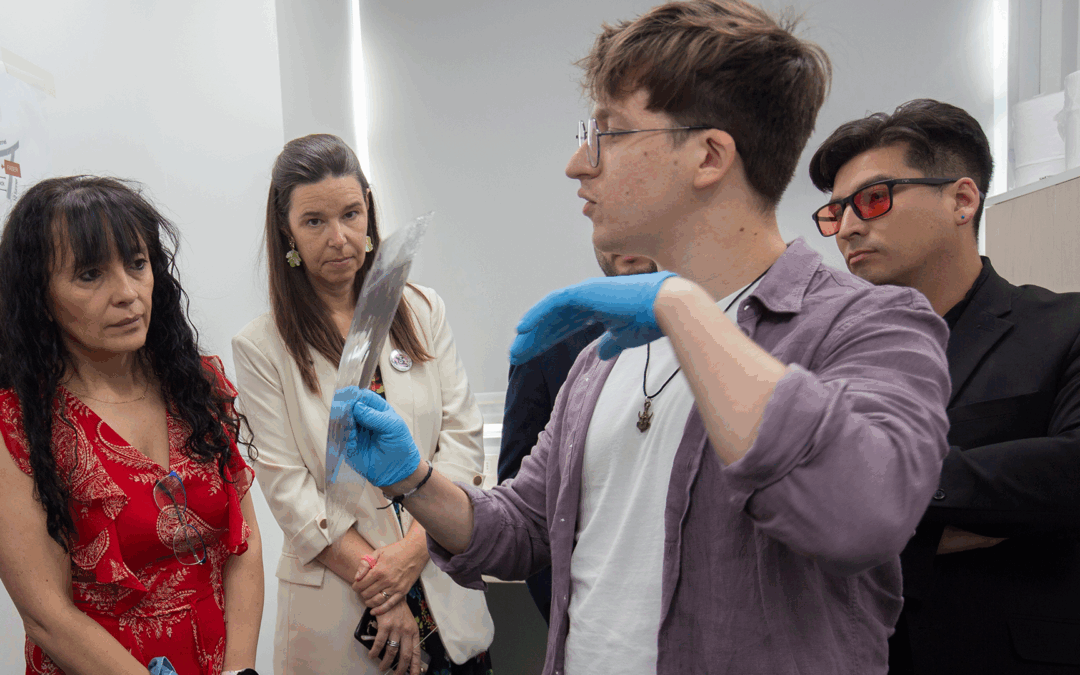
The Millennium Institute SAPHIR has been the scene of unique formative experiences, such as the one lived by Martín Bastías Görlich during his work at the CTEPP laboratory of the Universidad Andrés Bello, under the guidance of Professor Jilberto Zamora, SAPHIR associate researcher. There, Martín had the opportunity to operate the LASSO particle microscope, a piece of equipment of which there are very few in the world, and whose application is directly connected to the international experiment SND@LHC at CERN.
For Martín, this stage was both a challenge and an unrepeatable opportunity. "It was very enriching, both personally and professionally, since I had the chance to operate the LASSO microscope, and thus contribute a small grain of sand to the SND@LHC experiment through the scans made," he recalls. Beyond the technical aspect, he emphasizes a learning that marked him deeply: "science is a great collective work". Participating in a global project like SND@LHC and interacting constantly with CERN researchers reinforced his conviction that science advances thanks to shared efforts and a common goal.
His time at SAPHIR was complemented by a stay at CERN, an experience that, although brief, left a significant mark. "Having been able to interact with people there and breathe this scientific atmosphere was very enriching, because those places help to nurture this love for science," he says. Likewise, he highlights the value for him of having been responsible for a highly complex team in Chile: "the simple fact of having been able to work in a laboratory for months and being the person in charge of operating a microscope was not something I expected when I enrolled in the career, and I am very grateful to have had this opportunity."
The testimony of Martín Bastías clearly reflects the spirit of SAPHIR: to open spaces where young students can access frontier technologies, join international projects and project their scientific vocation towards new stages of professional development.