
Microelectronics is a branch of electronic engineering that focuses on the design, fabrication and integration of electronic circuits at microscopic scales. It uses advanced technologies to create devices such as transistors, semiconductors and other electronic components that enable highly complex equipment to function. This discipline has been key in the development of products such as computers, cell phones, communication systems and medical devices, transforming our daily lives by enabling miniaturization and improved performance of electronic devices.
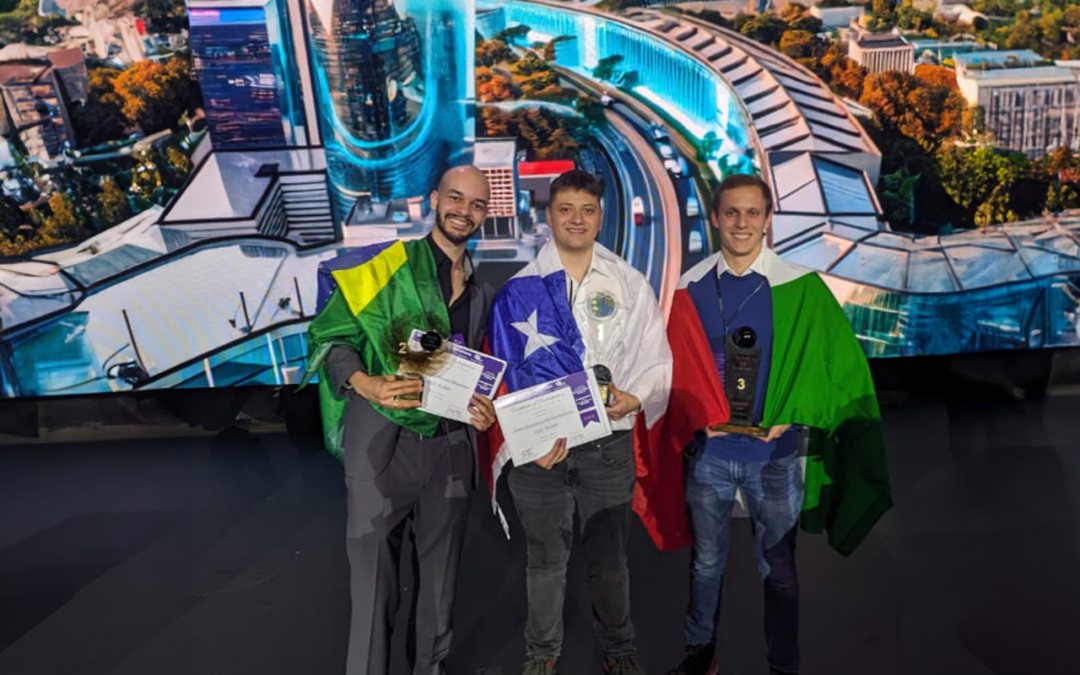
Recently, Vicente Corvalán, part of SAPHIR at the Pontificia Universidad Católica de Chile, participated in the Microelectronics Olympics held in Armenia, an event that brought together representatives from various countries, and where he won first place. "It was an incredible experience. I met many people who share my passion and I was able to learn a lot from them, in addition to making good friendships," says Vicente.
The test itself, in Vicente's own words, was "exhausting," with four hours of fairly complex development questions. "Although it was four hours, I would say I was a little short of time to be able to finish answering some questions," he adds.
Despite the challenge of the race, this event was a great opportunity for Corvalán. It allowed him to get to know Armenia and its culture, highlighting both the organization of the event and the warmth of its people.
"In addition to the competition, two conferences were held in which experts in the area presented the current challenges in microelectronics. One of the topics that caught my attention was the world of chiplets, an innovative proposal with a lot of potential. Not only in technical terms, I also had the opportunity to meet people from many countries, talk about their projects and experiences, which broadened my perspective and allowed me to understand how the challenges of microelectronics are addressed in different parts of the world. It was an enriching experience, both technically and personally, which undoubtedly motivates me to continue learning and growing in this field", explains Vicente.
On being crowned the winner of the Olympics, Vicente highlights the pride of representing Chile and emphasizes the quality of the professionals at his institute. "To have won is a tremendous source of pride and I hope that this will help put Chile on the map, since there is practically no industry in this area here."
Finally, about his work on the "Charge Monitoring Board" project at CERN, he comments: "It has been a very interesting and entertaining project, especially because it is my first time designing a circuit at that speed. I have learned a lot about PCB design and electronic design in general, which I consider very important for my professional training". In relation to particle physics, he adds: "My work is more focused on electronics and devices that allow measuring and characterizing the signals received from the detectors. It is a very interesting world, and I would love to continue contributing as an electronics engineer in the future."
CMS
The project "Charge Monitoring System"is a work developed at CERN for the ATLAS experiment, in which members of SAPHIR participate, linked to the Andrés Bello, La Serena, and Catholic Universities of Chile. Its purpose is to measure the charge extracted from the monitoring output (MO) of the TGC Amplifier-Shaper-Discriminator (ASD) plate (ASD and MO signals).
This load will be accumulated by a concentrator and analyzed to extract the maximum, mean and rms of the distribution, again allowing TGC monitoring.