The collaboration between the Millennium Institute SAPHIR and CERN's ATLAS project represents a significant advance in the positioning of Chile within frontier scientific research, especially in the field of subatomic particle physics. This strategic alliance has opened new opportunities for Chilean researchers and technicians to be actively integrated in one of the most ambitious experiments in the world, allowing direct collaboration in first level facilities such as the Rutherford Appleton Laboratory (RAL) in the United Kingdom.
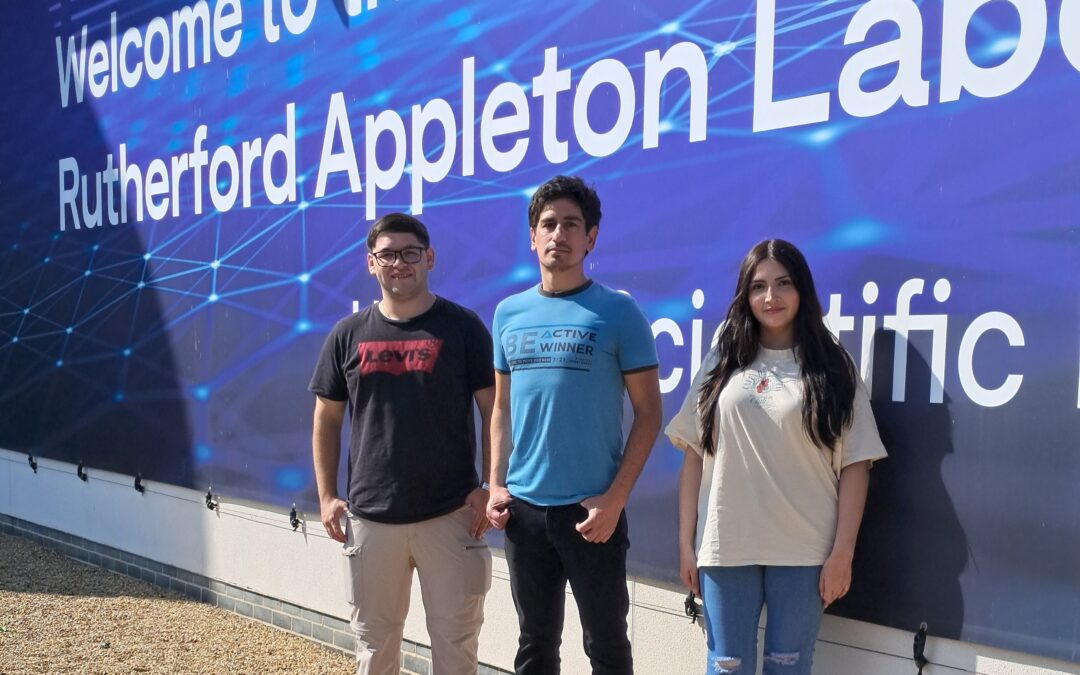
The participation of Inés Gutiérrez and Cristian Silva, both graduates of the Instituto Profesional AIEP, in the prestigious Rutherford Appleton Laboratory (RAL) in the United Kingdom, is the result of the formal collaboration between the Millennium Institute SAPHIR and AIEP. This strategic alliance has allowed the active incorporation of Chilean technicians to CERN's ATLAS project, generating real opportunities to participate in world-class laboratories. Their presence in the RAL not only reflects SAPHIR's commitment to technical training of excellence, but also the strengthening of Chile's role in frontier science at the international level.
SAPHIR has identified a structural gap in the Chilean research and innovation ecosystem: the absence of formal and sustainable mechanisms that allow the participation of qualified technicians in international frontier scientific projects. Therefore, the effort to sign an agreement with AIEP is aimed at contributing to the country in the training of technicians and providing opportunities for specialization and professional growth.
Testimonials from participants
Cristian Silva, a technician selected to participate in the project, expressed his enthusiasm for joining the ATLAS experiment team at the RAL:
"I feel enthusiasm and a great responsibility to have been selected. This opportunity not only represents a personal achievement, but also a reflection of Chile's growing position in science and technology, thanks to its recent incorporation as an associate member of CERN. My expectations are focused on making the most of this experience to learn, contribute and grow in an environment of international scientific excellence, where knowledge in particle physics, engineering and technology converge."
Inés Gutiérrez, also part of the team, shared her excitement and gratitude for the opportunity:
"I am very excited and eager to participate in this project, and grateful for the opportunity. I will be working as a lab technician in a clean room, which involves following rigorous protocols for handling highly sensitive components. I hope to develop hands-on skills in the assembly and quality control of silicon detector modules for the ATLAS Upgrade Phase II project, which aims to prepare the detector to operate efficiently in the High-Luminosity LHC environment, representing a large increase in the amount of data collected."
Inés also expressed interest in expanding her knowledge:
"I want to learn more about traceability systems, electrical testing and sensor characterization, as well as better understand the coordination between the different international centers involved in this phase of the experiment. This experience will allow me to consolidate knowledge in instrumentation and experimental techniques, as well as apply theory in an international collaborative context."
Elías Rozas, another SAPHIR staff member, underscored the challenging nature of this experience:
"The work at RAL will demand both technical and intellectual effort. I hope to accomplish the assigned tasks together with my team within the established deadlines, and thus leave a good impression. Although my role is primarily technical, I also hope to contribute in other areas where I can apply my intellectual capacity, without losing sight of the main objective."
Elías stressed the importance of this new stage in his career:
"Working for CERN is already a big deal. My previous participation in the construction of the muon detector wheels(New Small Wheel) was important, but this new challenge, which involves assembling parts of the central barrel of the ATLAS machine, exceeds all expectations. It will enrich my professional and academic profile. Being there, being able to work directly, is already a big step. In ATLAS, phenomena known by the Standard Model occur, but improving each detector will allow us to refine it even more and, who knows, maybe discover new physics. That motivates us all in a cross-cutting way."
Impact of this collaboration
Participation in the CERN ATLAS project represents a valuable opportunity for professional and academic growth in particle physics. The focus is on gaining hands-on experience in key areas such as high-precision electronic instrumentation, data acquisition and detection technologies, fundamental for frontier experiments.
Working in such a demanding and technologically advanced environment as the Rutherford Appleton Laboratory will allow participants to hone their technical skills and strengthen their professional profile. Academically, this experience will allow them to deepen their understanding of the convergence between electrical engineering and applied physics, knowledge that many hope to share with future generations of students in Chile.
A committed generation
In the framework of the recent incorporation of Chile as an associate member of CERN, this collaboration is not only an institutional achievement, but also a unique opportunity for young national talents to participate in experiments of global scale. The testimonies of Cristian Silva and Inés Gutiérrez show the commitment of a new generation to science, knowledge and the building of bridges between Chile and the international scientific community.