The ATLAS experiment corresponds to one of the detectors that make up
the "Large Hadron Collider" (LHC) at CERN. Through its application and
operation, it has been possible to investigate a wide range of concepts and
phenomena linked to modern physics, among them, we can find the
famous "Higgs Boson" and particles that could form the dark matter
.
-------------------------------------
"The LHC particle beams collide at the center of the ATLAS detector, which
generates collision debris in the form of new particles that leave
fired from the collision point in all directions. Six different
detection subsystems, layered around the collision point,
record the trajectories, momentum and energy of the particles, allowing
them to be individually identified. A huge magnetic system bends the trajectories
of the charged particles in order to measure their momentum", (CERN-WEBSITE).
Under this scenario, the Millennium Institute SAPHIR, through part of its staff at
Pontificia Universidad Católica de Chile, is working on the new challenges that
ATLAS generates, given the increase of collisions per second produced by the
LHC.
"The next stage of the LHC contemplates a remarkable increase in the number of
collisions per second, quintupling the current luminosity. This high
luminosity era of the LHC (HL-LHC), aims to refine the measurements by increasing the statistical
and reducing the uncertainties," says Bruno Zerega, part of SAPHIR
at PUC.
To meet this new challenge, ATLAS will perform a complete upgrade of
its internal detector. The innermost part of the detector will be replaced by a
array of silicon plates that will constitute the Inner
Tracker (ITk), which will have approximately 5 billion pixels that
will detect the trajectory of the charged particles created in the collisions.
"The flexes we are working with are printed circuits that constitute the
interface between the silicon plates, which will detect the passage of particles, and the
system that stores the information from that detection. It is through the flexes that the
process the information from the silicon pixels, allowing the identification of the
particles resulting from the collisions and their properties", says Zerega.
About Flexes
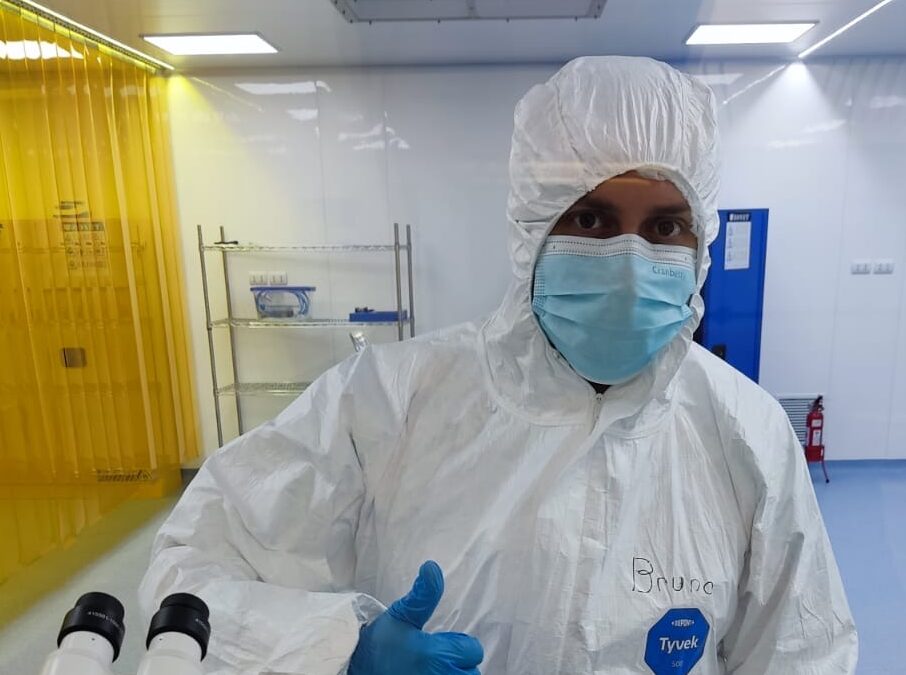
In the process of quality control of the flexes, Bruno's work is focused,
mainly on metrology. "First, I collaborated in the installation of the
quality control laboratory in the Clean Room of the Physics Institute of the
Pontificia Universidad Católica de Chile. During this phase, I studied the available
measurement methods and determined the accuracy of each one to qualify our
laboratory according to ATLAS requirements," he says.
Currently, he is in charge of measuring the dimensions of each flex and the thicknesses
of its different layers, performing periodic calibrations to the
measurement instruments.
Expectations of the testing process
At the moment, the ITk upgrade process is in the
preproduction phase of the flexes, during which the ability of the
manufacturers to meet the standards ATLAS requires for the
proper functioning of the detectors is evaluated. "This evaluation includes
metrology testing, visual inspection, and high and low voltage testing. In September
we performed the testing of the first batch of flexes and we are awaiting new
batches, which will start arriving in November and on which we will be
working throughout 2025," concludes Bruno.