Muons are elementary particles similar to the electrons in our atoms. But they are not found in atoms. They rain down on us as a cascade of particles from the sky, as they are generated by the interaction of cosmic rays (such as high-energy protons) with our atmosphere. They are little known particles, but they abound. They are almost 200 times more massive than electrons. They exist for about millionths of a second, but, thanks to Einstein's Special Relativity, they can travel great distances through space, as if defying time. They are particles that appear to be invisible, but we can see them by building the technology to do so on the ground. And this is precisely what the girls in Chile have been doing on their winter vacation. But why would the girls want to detect muons?
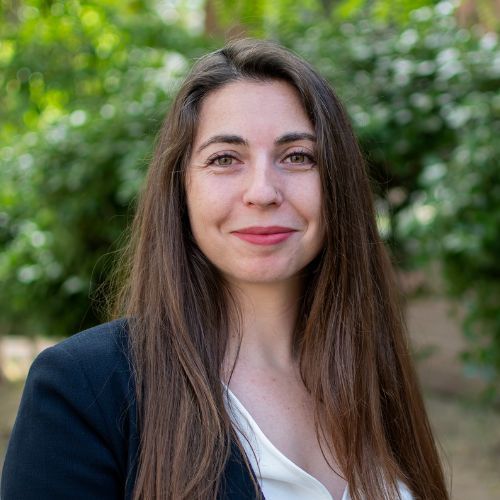
Giovanna Cottin
SAPHIR Research Associate
Since the year 2022 we founded, together with Francisca Garay, the initiative Atomic Girls. This is a scientific workshop under the auspices of the Millennium Institute SAPHIR, where about 30 girls from various regions of Chile, year after year have the opportunity to live the path of science. We guide them on this path. We lead a team of young scientists, who are at the same time tutors of the girls for two weeks, and who accompany them and show their progress and difficulties in the workshop.
Our initiative, which culminated its fourth version on July 3, 2025, starts with online theory classes on particle physics and electronics. The girls generate the foundations and inspiration needed to later build their own muon detectors. They come for two days to the teaching laboratories of the Physics Institute of the Pontificia Universidad Católica de Chile, where we work together. After building their own muon-counting detectors, they take data under various conditions. Subsequently, we teach them to analyze their data in practical programming classes. Throughout this process, we instruct them on the importance of being able to formulate concrete questions if one wants to understand the phenomena of nature. With this, the girls end the workshop by reporting their research results around some curiosity generated by the muons (for example, does the number of muons that I detect change if I move the position detector?)
This exemplifies a process of scientific thinking. And this is what we are interested in; that the girls are exposed to this process, from an early age and in a pleasant space, to be able to do it in freedom. And thus dare to question. Thinking critically about something involves having doubts about it. For example, I can ask, what are muons? If I want to know what muons are, I proceed to develop a methodology to access this knowledge. This is called the "scientific method". But it is not a recipe. It is a way of thinking in order to access knowledge of the world. A critical way of thinking, which asks and generates questions, which requires hard work and commitment to answer them, and tremendous humility in having to embrace various technical (and also human) difficulties around the development of ideas and complex experiments.
And we know that facing this process has value in itself. And this value begins to accumulate earlier if they start questioning things from an early age. We trust that this process not only prepares them for an uncertain world, where knowing how to ask clear questions can impact even their own well-being, but also gives them the opportunity to acquire cross-cutting, everyday skills. They can question how the electronic devices they use every day work. They approach the world of programming, and begin to glimpse that they may be able to translate human ideas into a logical language that computers can interpret. They have the opportunity to learn these languages and thus, the opportunity not to be left behind in the development of new technologies.
Finally, they are in a position to test their own predictions and reach their own conclusions. Sometimes with incomplete information, for example, by having to make decisions regarding their data and having to finalize their research reports within a tight deadline, even if the experiment failed. This also happens frequently in our professional development. All of these things happen or are fruits of living the path of science. There is an innate resilience in the path of science.
We trust then, not blindly, but thanks to the fact that we live and do science, that our workshop will help you to face the world in a better and more informed way. And this preparation, these weapons, these languages, these seeds and these bridges, are given by science. And science is made by people, so science needs girls. The world needs more prepared and informed people to face challenges, sometimes unexpected ones. It needs new tools, new languages, new ideas and new ways to push the frontiers of our knowledge. Then we can live in a more conscious, more interesting, more humble and more humane world.