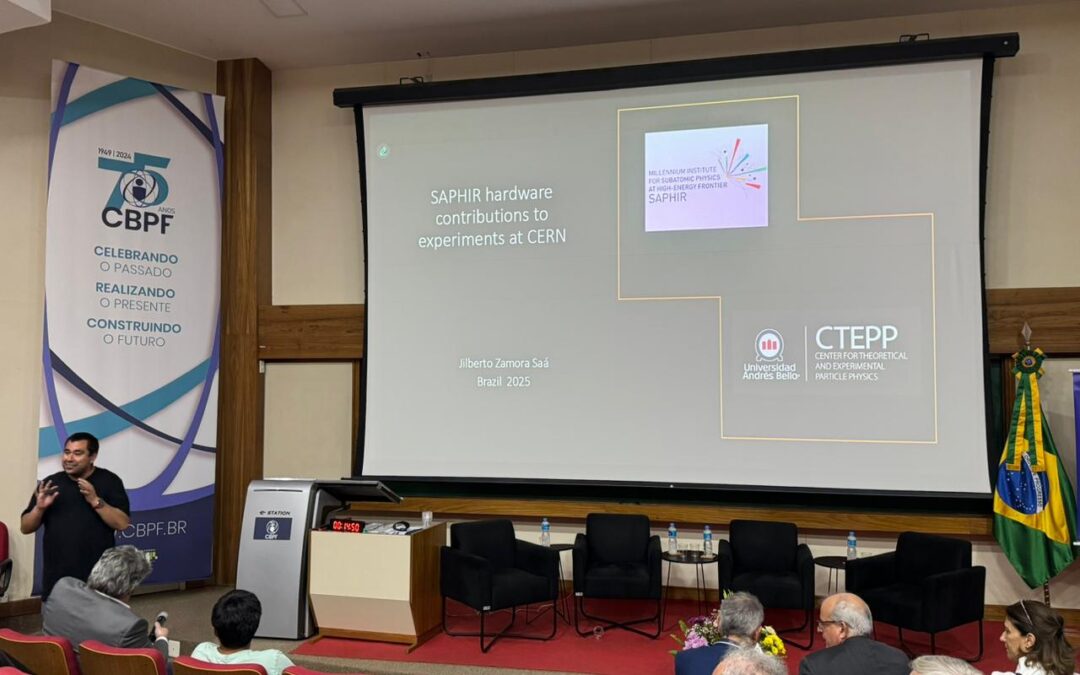
On November 14, the city of Rio de Janeiro hosted the CLAF Symposium, organized by the Latin American Physics Center (CLAF), an event aimed at strengthening regional scientific cooperation and promoting the exchange of knowledge on contemporary challenges in physics. The meeting brought together established researchers, institutional representatives and Latin American research centers, fostering discussion on technological advances, training of talent and prospects for collaboration in the coming years. Founded in 1962 with the support of UNESCO, CLAF was born after a series of Latin American Schools of Physics that began in 1959 in Mexico and continued in Argentina and Brazil, initiatives that led figures such as Juan José Giambiagi, José Leite Lopes and Marcos Moshinsky to promote the creation of a center dedicated to science in the region. Since then, CLAF has established itself as a key platform for training, academic mobility and integration of Latin American physics, promoting scholarship programs, scientific exchanges and meeting spaces that have marked milestones in the history of the discipline.
On behalf of the Millennium Institute SAPHIR, Dr. Jilberto Zamora, associate researcher of the Institute and academic of CTEPP-UNAB, participated. During his presentation, he gave a detailed overview of the Chilean contributions to the frontier experiments developed at CERN, highlighting the advances of the team in projects such as ATLAS, SND@LHC, NA-64 and SHiP. Zamora discussed SAPHIR's role in the implementation of the new MOPS-HUB system for the ITk detector of the ATLAS experiment, whose production and quality control is carried out both at CERN laboratories and at Universidad Andrés Bello's facilities in Chile, positioning the country in the development of specialized scientific hardware.
He also addressed the neutrino physics program through the SND@LHC experiment, where the Chilean team designed and built the ColdBox -a structure with borated polyethylene and acrylic coatings oriented to mitigate neutron flux- and actively participates in data analysis, flux measurements, prototyping and detector testing for future versions of the experiment.
He also presented the advances in NA-64, an initiative dedicated to the search for dark photons, for which SAPHIR has contributed with the construction of detectors, simulations, an SRD system based on LYSO crystals and the design of a calibration platform of up to eight tons for HCAL, with sub-millimeter precision and automated control.
Finally, Zamora emphasized that these contributions not only consolidate Chile's presence in cutting-edge experiments, but also boost national capacities in research, engineering and the training of new generations of scientists.
For his part, SAPHIR's International Area Director, Jack Brady, participated in the Panel "Chilean Participation and Association to CERN", together with Dr. Hayk Hakobyan, CCTVal's Alternate Director, and Rodrigo Pacheco, CCTVal's Executive Director. In this space, Brady highlighted the mechanisms that have allowed Chile to strengthen its participation in CERN, SAPHIR's articulating role in high impact collaborative projects and the need to strengthen the national scientific infrastructure to consolidate a sustainable ecosystem of advanced research. The event made visible the path that the country is currently following to integrate technological capabilities, young talent and international cooperation, projecting an increasingly robust positioning in high energy physics and in the production of frontier scientific knowledge.
SAPHIR's participation in the CLAF Symposium: Chilean advances in frontier physics and collaboration with CERN