The development of new knowledge, at the forefront of technologies and the dynamism that characterizes the scientific community, is undoubtedly an important and complex task. The time required to collect data and background information to build new information boxes is extensive and requires long days of analysis, in which data are processed and logs are established to record the results.
In the area of particle physics, one of the objectives of the SAPHIR Millennium Institute is data collection, storage and subsequent analysis. For example, the Large Hadron Collider (LHC) at CERN records the passage of each particle as a series of electronic signals, which are sent to a data center for digital reconstruction.
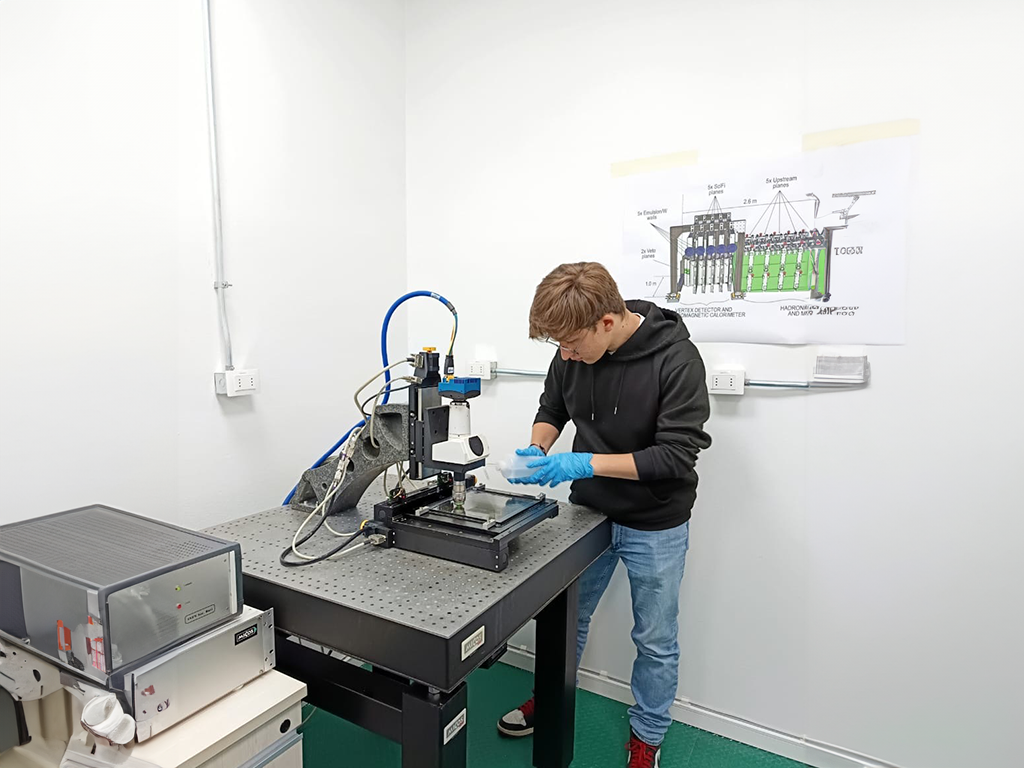
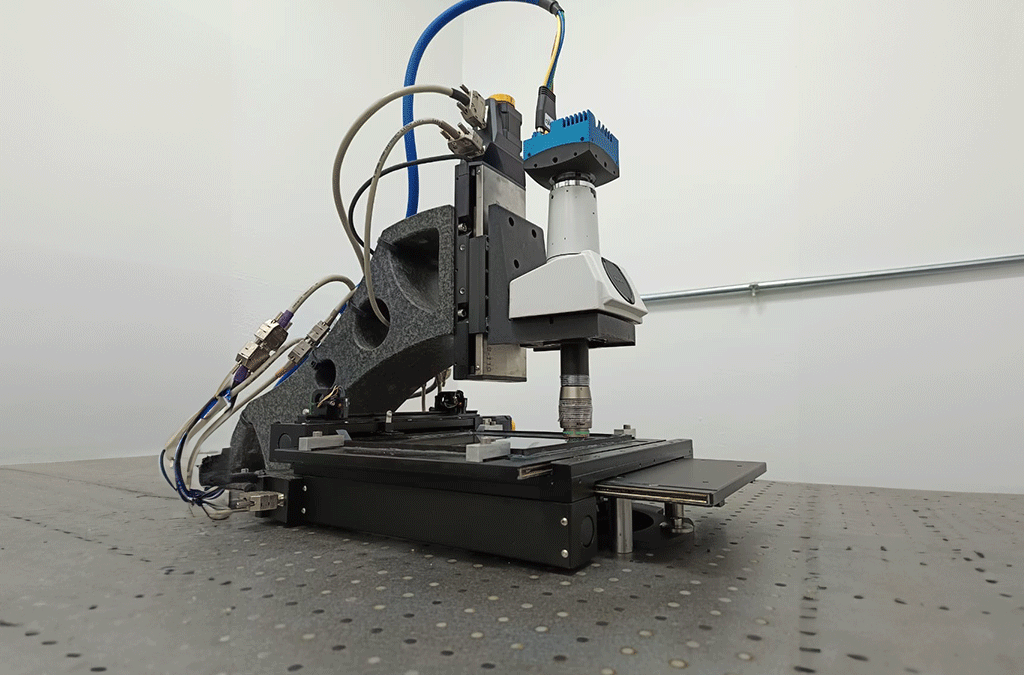
In this context, and thanks to the international collaboration with the University of Naples Federico II, and to the management of the Professor Giovanni De Lellis, the Millennium Institute SAPHIR has a microscope assembled and configured with a software called "Large Angle Scanning System for Opera" (LASSO), which allows the study of neutrino oscillations - muon to tauon.
In charge of this task is Martin Bastías Görlich (24 years old), an undergraduate student of Engineering Physics at Universidad Andrés Bello. Martin is in charge of monitoring the data collection and subsequent sampling analysis. "Being able to work with this microscope was decisive for my interest in the area, not only because of the particle analysis, but also because of the possible applications. This is my first approach with subatomic particles; what I always see in the courses in a theoretical way, here (at SAPHIR), for the first time, I see it from an experimental scenario", explains the student.
Monitoring, calibration for each sample and entering the parameters into the system are some of Bastías' tasks with the microscope. In this sense, he adds: "I would like to continue working with this machine, especially for its performance in scanning aspects and for its great capacity to generate data, which can be applied in areas such as geology, medicine, cosmology, nanostructures and materials analysis, among others. On the other hand, this microscope has already been used to analyze emulsion plates, muon radiography and has had applications in medical physics, so why stop there? There are so many applications. That's what I find so interesting," he emphasizes.
Regarding his upcoming trip to CERN, the young man says: "It's a dream to get there", and his expectations are related to enriching his scientific knowledge and broadening his contact networks. "I'm looking forward to learning from both the professional and personal experiences of the researchers at CERN," he concludes.