
The NA64 experiment at CERN is a fixed-target experiment whose purpose is to search for a new vector Boson (A′), called dark photon, which could mediate the interactions between visible and dark matter. This experiment was designed to search for new physics, beyond the "Standard Model", particularly dark matter and hypothetical particles, such as dark photons (A) and axions.
This objective is crucial because dark matter makes up the largest part of the universe and remains one of the greatest enigmas of modern physics.
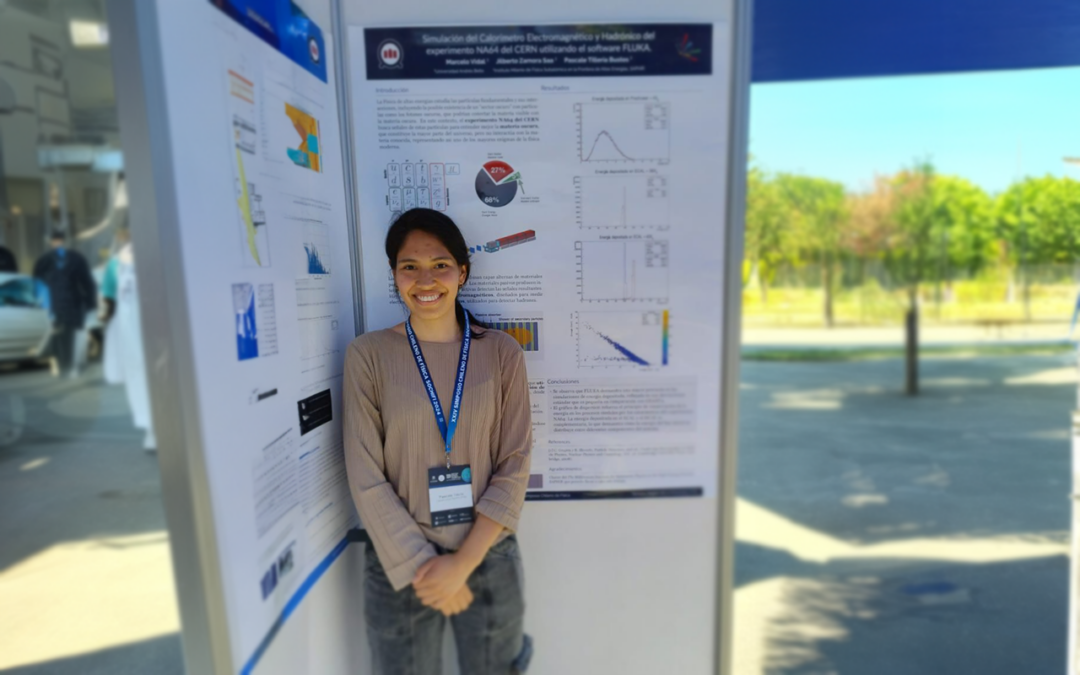
In this context, our student Pascale Tillería, was recently selected as the winner of the best poster in the first day of the "SOCHIFI 2024". The presentation of the student of our associate researcher, Dr. Jilberto Zamora, is based, mainly, on the use of simulations performed with the "FLUKA" software to model the particle interactions in the Electromagnetic Calorimeter (ECAL), and the Hadronic Calorimeter (HCAL) of the NA64 experiment at CERN. Providing a detailed description of both, using an electron beam.
"The work cited in the poster includes key references such as the paper by "Dark matter search in missing energy events with NA64"published in Physical Review Letters (2017). This paper details the goal of the NA64 experiment, which seeks to detect dark sector particles: such as dark photons, through missing energy events. It also uses design concepts and theoretical principles described," explains Pascale.
To model the beam characteristics, Tillería used FLUKA, together with the precise geometry of the Hadronic Calorimeter (HCAL), and deposited energy measurements. "This work involved defining the properties of the particle beam to mimic real experimental conditions. It also involved building a detailed geometrical model of the Hadronic calorimeter, considering the alternating layers of passive and active materials, and calculating the energy deposited in the detectors," he explains.
Projections in the field of physics and dark matter.
"I am motivated to continue my studies in physics and contribute to the advancement of scientific knowledge by addressing fundamental questions that could explain the nature of, for example, dark matter. In that context, I would love to pursue a PhD, as it represents an invaluable opportunity to further develop my research skills and, deepen the study of these fascinating phenomena," emphasizes Pascale Tillería.
Currently, Pascale's focus is on Particle Physics, especially in the simulation of the hadronic Calorimeter, in the collaboration of the NA64 project. "I am eager to achieve my dreams and I am determined to walk the challenging path of academia, committed to research, continuous learning and discovery. As Richard Feynman rightly says: 'Study much that is of interest to you and do it in the most undisciplined, irreverent and original way possible,'" she concludes.