One of the main missions of our institute throughout its first 5 years of existence has been to promote the formation of advanced human capital and to support training at both the undergraduate and graduate levels.
Strengthening and forging new collaboration networks, and fortifying the ones we have already generated, are part of the strategy that has allowed us to have a stable and recurrent flow of personnel between SAPHIR and CERN. In this way, many of the people who make up our technical and scientific team have been able to travel, are currently there or will travel in the future to Switzerland to enrich their knowledge and, in addition, to test and export, in some cases, hardwares that are developed at SAPHIR and that are directly related to some of the large experiments currently underway at the European Organization for Nuclear Research (CERN).
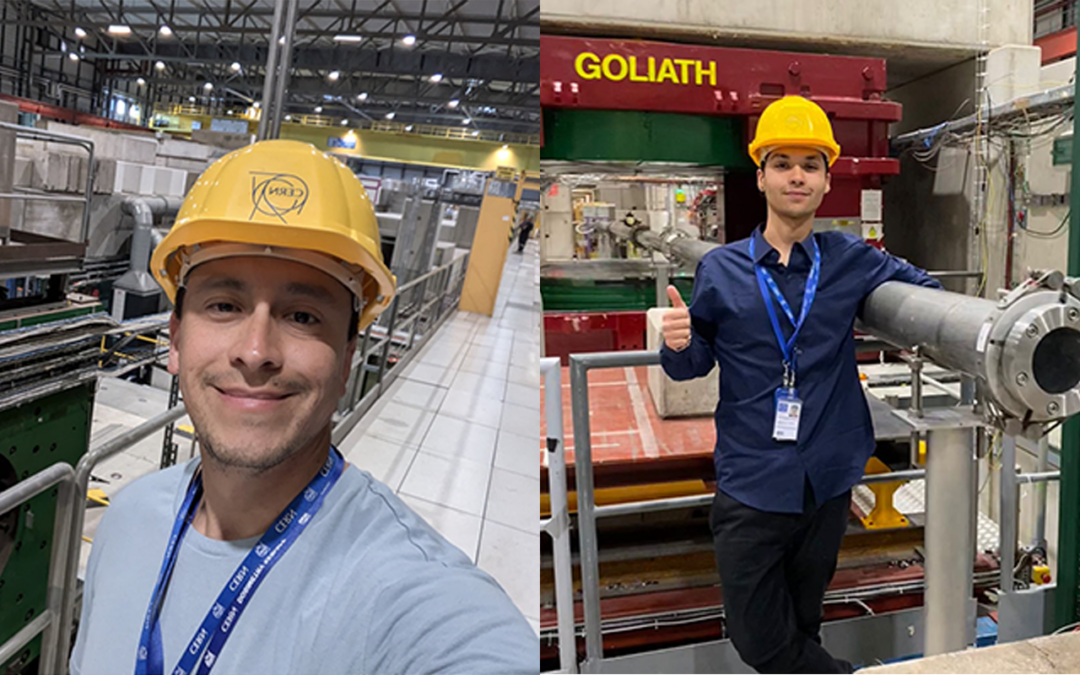
José Luis Soto Pezoa and Matías Tobar Toledo are undergraduate students from our institute who traveled to CERN. José Luis (Engineering Physics UNAB), summarizes his experience as "quite a challenge". He adds: "From the moment I arrived, I was amazed by the magnitude of the technical, engineering and scientific work being done there".
Under this scenario, José Luis also notes that: "It is incredible to see how everyone collaborates to achieve such ambitious goals, which reaffirms why CERN is the epicenter of particle physics and, in addition, the high level of the group studying this area from Chile. Participating in the "test beam", where I worked in the assembly, control, analysis and data collection, was a transforming experience that will continue to be enriched as I analyze the data".
On the other hand, Matías Tobar, comments that the word that sums up his experience at CERN is "gratifying". In this sense, he adds: "Almost everything was new to me and that was challenging, but, above all, very exciting. I participated in the preparation of detectors and their positioning in the "SPS North Area. One of the most diverse experimental facilities, it supplies proton, hadron, electron, muon and ion beams to more than 200 user teams each year for detector research and development and to the NA61, NA62, NA64 and AMBER experiments [Source: CERN]).
In this context, Matias highlights the great amount of knowledge acquired, which, in his own words: "I am ready to apply in different work environments with different work teams".
The students' tutor and SAPHIR researcher, Dr. Marco Ayala, reflects: "The possibility of developing these internships reflects the continuous training that has always been sought at the institute. Both José Luis and Matías participated in SAPHIR's summer internships, working with part of the detectors that were tested in the beam test, with some modifications and adaptations under real conditions". In this sense, the academic emphasizes: "Both had the opportunity to participate in different stages in the production of detector technology for frontier experiments," he explains.